Since 2024, Brittany has established itself as a major summer alternative to destinations affected by the heatwave, with a coastal occupancy rate exceeding 90% in the heart of summer. This dynamic is reshaping French tourist flows and placing the peninsula in an unprecedented economic position.
RevPAR, attendance, and the economic paradox of Breton tourism in 2026
We observe a clear disconnect between attendance indicators and actual financial returns. The 2026 season shows stable attendance compared to 2025, but economic returns are declining. The explanation lies in a change in behavior: visitors are seeking cheaper options, shortening their stays, or opting for non-commercial accommodation.
RevPAR is rising (nearly 20% compared to 2024), benefiting classified hotels. In contrast, local businesses, restaurants, and activity providers are absorbing visitors’ budgetary caution. This phenomenon is not unique to Brittany, but it is amplified there by the short seasonality of the northern coast, where the profitability window concentrates on six to eight weeks.
Professionals in Morbihan and Côtes-d’Armor are noticing this: a high occupancy rate no longer guarantees an increase in revenue. The correlation between overnight stays and average spending per stay has weakened, and the 2026 season confirms this structural trend. For more in-depth regional data, a useful resource is: https://www.bretagne-region.com/, which aggregates indicators for the area.
Overtourism on the Breton coast: real tension or amplified perception
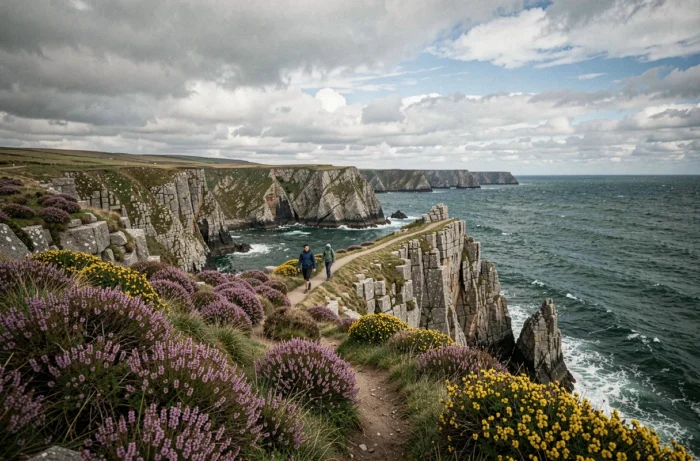
Anti-Parisian tags that have appeared on some facades in Finistère and Morbihan have circulated widely on social media. They reflect local tension, but reducing the phenomenon to a rejection of tourists would be too quick a reading. Breton overtourism is primarily an infrastructure problem: saturated parking, sewage networks designed for towns of a few thousand inhabitants, coastal paths eroded by concentrated foot traffic on the same sections of the GR 34.
Some municipalities are testing regulatory measures (shuttles from park-and-ride lots, limits on natural sites), but without a binding regulatory framework at the regional level. We recommend monitoring the flow management initiatives implemented by the southern coastal intercommunalities, which foreshadow what other territories will need to adopt.
The pressure is not evenly distributed. The interior of Brittany, from the Brocéliande forest to the Nantes-Brest canal, remains largely under-visited. The coastal/backcountry imbalance is the real issue, not the overall volume of visitors.
Festivals and events in Brittany: a calendar that structures the season
Brittany’s cultural programming goes beyond folklore. Festivals serve as a measurable economic lever and a tool for de-seasonalization that few French regions master as well.
- Les Vieilles Charrues in Carhaix, located in central Brittany, irrigate a territory far from the coast and attract a considerable audience each year
- The Interceltic Festival of Lorient, in August, generates a peak in overnight stays in Morbihan and highlights Celtic culture as a living heritage, not as a museum reconstruction
- The Transmusicales in Rennes, in December, prove that a winter event can fill hotels in a Breton metropolis off-season
- The Festival de Cornouaille in Quimper combines dance, music, and fest-noz in a format that attracts both connoisseurs and the curious
This festival network is a structural asset. It spreads flows over time and space, where other regions concentrate their event offerings in a single city or period.
Heritage and landscapes of Brittany: three elements to know
The alignments of Carnac, Pointe du Raz, Saint-Malo intra-muros: these sites are documented everywhere. Three elements deserve particular attention.
The pink granite heritage of the northern coast (Ploumanac’h, Trégastel) is not just a photographic backdrop. The local geology produces unique formations in Europe, and their fragility in the face of erosion and pedestrian traffic is subject to scientific monitoring by the Conservatoire du littoral.
The parish enclosures of Finistère (Guimiliau, Saint-Thégonnec, Lampaul-Guimiliau) represent an architectural ensemble from the 16th and 17th centuries without equivalent in France. Their attendance remains modest, making them a useful counterpoint to the saturated coastal sites.
The Gulf of Morbihan, classified among the most beautiful bays in the world, presents a case study in environmental management. The coexistence of oyster farming, boating, and tourism is a constant balance, not a given.
Brittany is undergoing a transition phase: attendance remains stable but the tourism economic model is weakening. Professionals who anticipate this shift by diversifying their offerings towards the backcountry, targeting the inter-season, and integrating environmental constraints will be those who benefit from the new French tourism landscape.