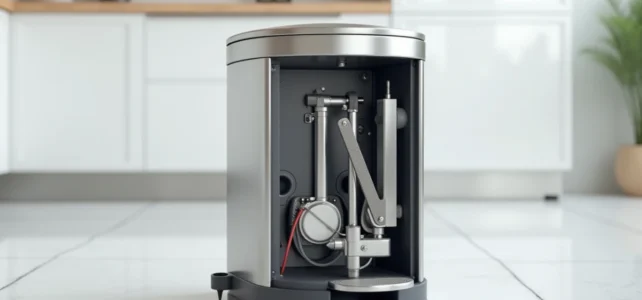
Press the pedal, see the lid lift, throw away your waste, release. The action takes less than two seconds. The mechanism that makes it possible relies on an assembly of parts, each playing a specific role. Understanding how a pedal bin works allows for better model selection, diagnosing a malfunction, and extending its lifespan.
Connecting rod and pivot: the force transmission in a pedal bin
Have you noticed that a downward movement (foot on the pedal) produces an upward movement (the lid lifting)? This reversal of direction is based on a simple physical principle: the lever.
The pedal is attached to the body of the bin by a rotating axis, called a pivot. When the foot presses down, the pedal tilts around this pivot. A rigid rod, often metal, connects the pedal to the lid. This rod transmits the force upward.
The pivot acts as a fulcrum. On one side, the foot pushes down. On the other, the rod pushes the lid up. It’s the same principle as a seesaw: when one side goes down, the other goes up. To better visualize this transmission chain, the diagram of the bin opening mechanism details each part and its position in the assembly.
The connecting rod converts a downward vertical movement into an upward vertical movement. Its length and angle of inclination determine the lid’s opening amplitude. A rod that is too short limits the angle. A misaligned rod causes lateral play that prematurely wears out the joints.
Return spring and damper: controlling the lid’s closure
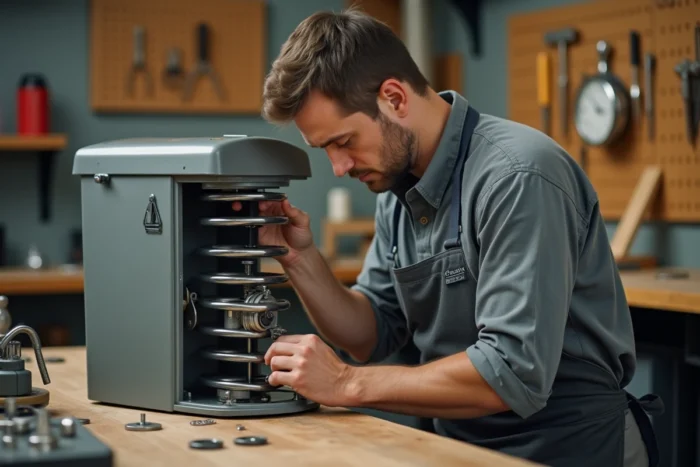
Without a spring, the lid would remain open after the pedal is released. The return spring stores the mechanical energy produced during opening and then releases it to bring the lid back to the closed position.
Two types of springs coexist depending on the models:
- The torsion coil spring, wound around the lid’s axis. It compresses during opening and relaxes during closing. It is found in most plastic or steel kitchen bins.
- The gas strut (or pneumatic damper), a small cylinder filled with pressurized gas. It slows the lid’s descent to avoid a loud slam. This system is found in higher-end models.
- The leaf spring, a flat metal strip that bends under stress. More rare, it is found on some compact bins where the internal space is limited.
The gas strut deserves special attention. Inside the cylinder, a piston separates two chambers. The gas passes from one chamber to the other through a calibrated orifice. This controlled passage of gas slows the lid’s closing speed. The result: a slow and silent descent, without slamming.
When a pedal bin starts slamming shut, the strut has lost some of its gas charge. Replacing this part, often sold separately, restores the lid’s gentle closure.
Plastic or metal pedal: what changes for durability
The material of the pedal directly influences the longevity of the mechanism. Plastic (polypropylene, ABS) absorbs shocks but deforms over time under repeated stress. Metal (stainless steel, aluminum) resists mechanical fatigue better but transmits more vibrations to the connecting system.
A metal pedal on a metal pivot lasts several years without notable mechanical play. A plastic pedal on a plastic pivot develops play more quickly, especially under intensive use (family kitchen, community).
The choice of material for the bin’s body also matters. A steel body offers better rigidity to the entire mechanism. The anchor points of the pivot and rod undergo less deformation. On a lightweight plastic body, these same points can deform under repeated stress, misaligning the rod and making the opening irregular.
Pedal bin and organic waste sorting: a constraint that changes design
Since January 1, 2024, all individuals and businesses in France must sort their organic waste at the source. This obligation, stemming from the AGEC law, changes expectations regarding the closing mechanism.
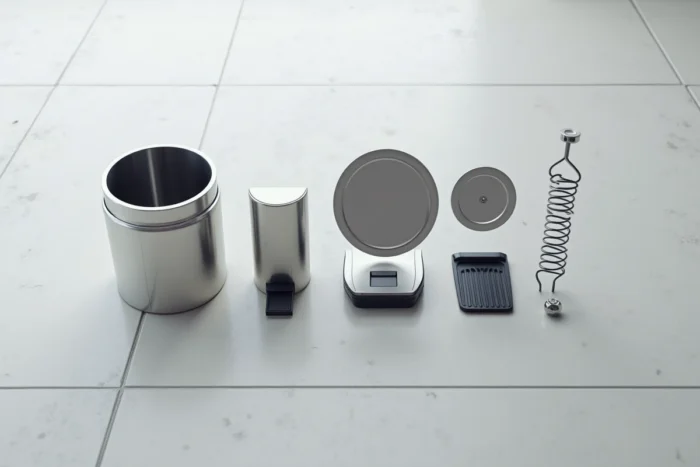
Organic waste (peels, food scraps) generates odors and attracts insects. The lid must ensure an airtight closure, not just an aesthetic one. A silicone or rubber peripheral seal around the lid blocks the diffusion of odors. This seal adds to the mechanical system without modifying it, but its absence makes the pedal bin unsuitable for organic waste flow.
Manufacturers are directing their models towards materials that are easy to disinfect (smooth stainless steel, antibacterial plastic) and compatibility with compostable bags. The pedal mechanism remains highly relevant here: hands-free opening limits cross-contamination between organic waste and the user’s hands.
Diagnosing a malfunction in a pedal bin mechanism
The pedal is unresponsive, the lid is stuck, or it falls too quickly. Before replacing the bin, three checks are usually sufficient:
- Check the connecting rod. If it is detached from its attachment point (pedal side or lid side), simply reclip it or replace the fixing pin.
- Examine the spring or strut. A relaxed spring no longer brings the lid back. A strut that no longer slows the descent has lost its charge. In both cases, the part can be replaced individually.
- Inspect the pedal pivot. If the pedal moves laterally with play, the pivot axis is worn or broken. On plastic models, this part breaks cleanly. On metal models, it wears down through friction.
The majority of malfunctions come from the detached connecting rod or the fatigued spring. Repairing rather than replacing extends the bin’s lifespan by several years. Spare parts (rods, struts, springs) are available from most manufacturers or at hardware stores.
The mechanism of a pedal bin remains deliberately simple. Few parts, few friction points, an accessible lever physics. This simplicity explains why, despite sensors and motorized systems, the mechanical pedal continues to equip the vast majority of kitchen bins and professional containers.