The French automotive market is undergoing an unprecedented structural reshaping. 100% electric cars reached a monthly market share of between 35% and 38% in July-August 2026, according to the MAP Observatory of the Automotive Platform (PFA), more than double their share a year earlier. Gasoline and diesel are experiencing what analysts describe as a collapse. Here, we analyze the technical, fiscal, and market dynamics that are reshaping the automotive landscape in France.
CO2 Tax and Weight Tax 2026: The Double Fiscal Squeeze Reshaping Supply
The tightening of the CO2 tax in 2026, combined with the strengthening of the weight tax, creates a scissors effect on manufacturers’ catalogs. The trigger thresholds have been lowered, now affecting segments that were previously spared, including some compact thermal and mild hybrid SUVs.
This fiscal tightening pushes manufacturers to accelerate the withdrawal of intermediate thermal engines that have become unprofitable after taxation. Renault, Volkswagen, and Citroën are adjusting their ranges by removing or downgrading high-emission trims.
The impact is also spreading to the used car market. A recent thermal vehicle with a high tax burden at first registration loses its residual value more quickly. We observe that this fiscal pressure makes used electric vehicles more competitive compared to thermals, whose total cost of ownership is increasing.
To continuously follow these regulatory developments and their consequences on prices, auto news on Actu Auto Buzz provides a useful information thread on the subject.
New Electric Cars in France: Why Analysts Speak of a Point of No Return
The threshold of 35% monthly market share for 100% electric vehicles marks a recognized technical threshold in energy transitions. According to Automobile Propre, 2026 is described as the year of the point of no return for the French market. Electrified powertrains (pure electric and hybrids combined) already account for over 80% of registrations in certain months.

This concentration changes the industrial logic. Distribution networks are investing in high-voltage workshops, mechanic training programs are being restructured, and corporate fleets are shifting massively. The site Make a Move documents this acceleration on the fleet side, where registrations of electric vehicles are growing at a faster pace than the private market.
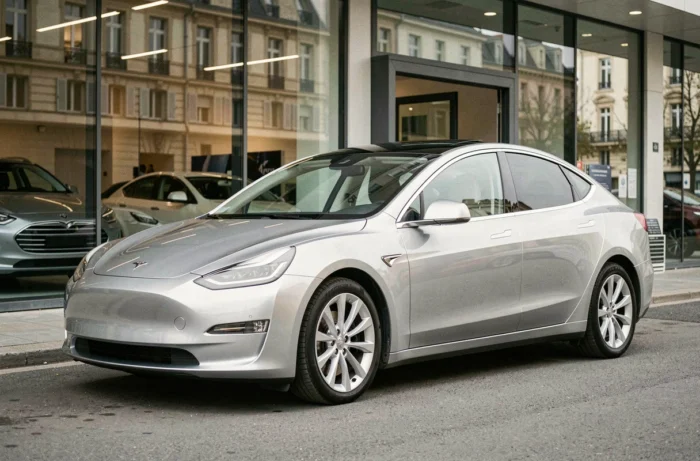
Tesla maintains a strong position in the premium segment, but competitive pressure comes from Renault with the electric R5 and from Citroën in the entry-level market. Volkswagen is trying to regain ground with the revamped ID range, although its internal restructuring (up to 4,000 jobs threatened at Jaguar Land Rover, by comparison) illustrates the tensions in the European sector.
Hybrids and Plug-in Hybrids: A Contested Transitional Role
Hybrid vehicles remain present in registration figures, but their relative share is stagnating. Plug-in hybrids suffer from a credibility deficit: real-world consumption in mixed use often exceeds homologated values, reducing the fiscal advantage and ecological argument.
Non-plug-in hybrids still hold interest for mixed trips without charging infrastructure, but the rapid deployment of charging stations in France reduces this advantage each quarter. We recommend that buyers consider the real cost over five years rather than just the catalog price.
Used Electric Cars: New Bonus and Limits of the Scheme
A new purchase bonus for used electric cars came into effect in September 2026. The aid aims to make the secondary electric market accessible to households excluded from new purchases due to pricing. On paper, the scheme complements the CEE bonus and the obligation to display battery health status, two measures already in place.
Numerama describes this new bonus as “particularly disappointing” in terms of amount. Le Journal de l’Auto reports that, in practice, the aids show their limits, as illustrated by the documented case in Rambouillet (Yvelines), where the commercial impact remains marginal.
- The display of battery health status (SOH) represents a step forward for transparency, but measurement protocols vary by manufacturer, complicating comparisons between models.
- The CEE bonus combined with the new aid does not always suffice to offset the rapid depreciation of early electric models (low-capacity batteries, limited range).
- The used electric market is still increasingly appealing according to Auto Plus, with a continuous increase in transactions on specialized platforms.

Reliability and Prices of Electric Vehicles: What the Market Reveals in 2026
The question of the reliability of electric vehicles is posed differently than that of thermals. The absence of a traditional gearbox, clutch, and exhaust system reduces common mechanical failures. However, battery replacement costs remain the main risk factor for the used buyer.
New electric prices have begun a gradual decline due to competition and the increase in production line volumes. Renault positions its models at more accessible prices than the previous generation. Tesla regularly adjusts its prices based on stock and demand.
On the fleet side, the total cost of ownership (TCO) of an electric vehicle becomes competitive over three to four years for urban and suburban uses. Profitability directly depends on access to on-site charging, a parameter that many fleet managers still underestimate.
Used Thermal Vehicles: An Accelerating Depreciation
The French vehicle fleet remains predominantly thermal, but the depreciation dynamic is reversing. Recent diesel models are losing value more quickly than before, due to the combined effects of traffic restrictions in ZFEs and fiscal pressure. Gasoline vehicles are holding up better, but the trend is clear.
The French automotive market is entering a phase where purchasing choices, both new and used, are made as much on fiscality and usage costs as on acquisition price. The coming months will determine whether public aids manage to smooth the secondary electric market or if the gap between political ambitions and economic realities persists.