After a stroke, the question of resuming driving quickly arises for patients whose daily lives depend on mobility. The French regulatory framework imposes specific steps, but a peculiarity of the system creates a blind spot: the absence of systematic medical checks upon the renewal of the B driving license. What are the timelines, what evaluations exist, and what discrepancies are there between legal theory and actual practice?
Absence of systematic medical examination: the paradox of the B driving license after a stroke
Most content on resuming driving post-stroke details the steps to follow once the condition is declared. They overlook a structural fact: there is no mandatory medical visit for the B driving license upon renewal in France, even after the latest reform of the regulatory framework.
In practice, only professional drivers (licenses C, D) or those summoned by the prefecture undergo a check. For the B license, the initiative to report a stroke rests entirely on the driver or their doctor. A patient who has had a stroke can therefore continue to drive without any intervention from the administration, as long as they do not declare their condition.
However, the Highway Code requires that one must be “constantly in a state to execute comfortably and without delay all maneuvers.” This dissociation between legal obligation and the absence of a verification mechanism constitutes an identified risk point in forensic medicine. It explains why the patient’s voluntary approach remains the pivot of the entire process. The ability to drive after a stroke thus depends on a declarative act that nothing administratively constrains for holders of the B license.
Temporary incompatibility timelines: minor, moderate, or severe stroke
The timelines before any resumption of driving vary according to the severity of the stroke and the residual effects. The decree of August 31, 2010, sets the framework, but medical practices add nuances that the text alone does not reflect.

| Type of Stroke | Minimum Delay Before Resumption | Prerequisite Condition |
|---|---|---|
| Minor stroke (without rehabilitation) | 15 days | Identification of visual, sensory, motor, and cognitive impairments, followed by consultation with a doctor approved by the prefecture |
| Moderate to severe stroke (rehabilitation necessary) | At least 1 month | Multidisciplinary assessment of driving capabilities, prescribed by a doctor or requested by the patient |
| Transient Ischemic Attack (TIA) | Variable depending on residual effects | Temporary incompatibility depending on the nature of the deficit, opinion of the approved doctor |
The 15-day delay for a minor stroke may seem short. It does not mean automatic resumption: the patient must first see a doctor approved by the prefecture, distinct from their treating physician or neurologist. This doctor assesses overall fitness and may impose restrictions (daytime driving only, limited area, vehicle modifications).
For moderate to severe strokes, the multidisciplinary assessment is the determining step. It involves a neurologist, neuropsychologist, and sometimes an occupational therapist specialized in driving. The actual delay between the stroke and the effective resumption of driving often exceeds several months, regardless of the minimum regulatory delay.
Assessment of driving capabilities post-stroke: what is actually tested
The assessment is not limited to a motor examination. Cognitive and behavioral sequelae represent the least visible but most frequent obstacles to safe driving.
- Visual abilities: visual field, acuity, unilateral spatial neglect (common after a stroke affecting the right hemisphere), ability to spot peripheral obstacles.
- Cognitive functions: information processing speed, divided attention (managing the steering wheel, mirrors, and signage simultaneously), working memory, executive functions (anticipation, route planning).
- Motor and sensory abilities: grip strength on the steering wheel, foot sensitivity on the pedals, coordination of upper and lower limbs, sufficient joint range for maneuvers.
- Behavior and awareness of deficits: anosognosia (the patient does not perceive their own limitations), impulsivity, tolerance to fatigue during prolonged trips.
Anosognosia deserves particular attention. A patient convinced they can drive normally while their attentional functions are impaired poses a risk that neither the treating physician nor their surroundings always detect. It is often the neuropsychologist who identifies this discrepancy during standardized tests.
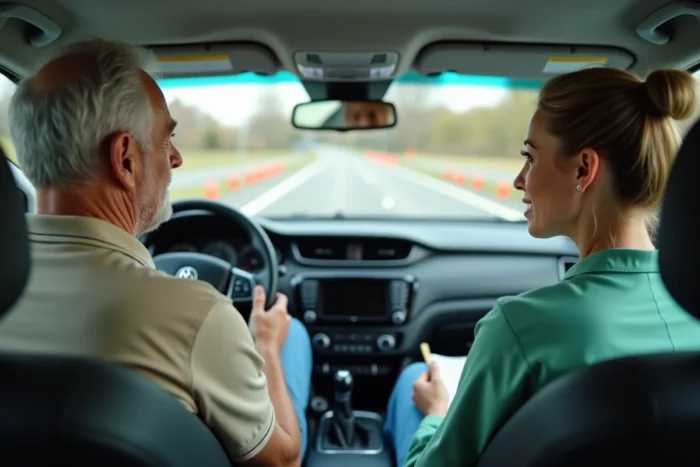
In some specialized centers, a road or simulator situation complements the assessment in the office. The road test remains the only evaluation that reproduces real driving conditions, managing traffic, unexpected events, and accumulated fatigue.
Vehicle modifications and license restrictions
The approved doctor can issue a favorable opinion with codified restrictions on the license. Common modifications include a ball steering wheel, left-foot accelerator, and steering wheel controls for turn signals or automatic clutch. These adaptations require specific training with a certified driving instructor.
The validity period of the license may be limited, imposing periodic medical renewal. This periodicity varies according to the observed sequelae: some patients are reassessed every year, others every two to five years.
Car insurance and declaration obligation after a stroke
One aspect rarely addressed concerns car insurance. The car insurance contract requires the declaration of any change in health status that may affect driving. A stroke falls into this category.
Failing to declare a stroke to one’s insurer exposes one to a nullification of coverage in the event of a claim. The insurer may refuse to compensate if the investigation reveals an undisclosed condition that contributed to the accident. This obligation exists independently of the favorable opinion of the approved doctor: even with a valid license and restrictions adhered to, the absence of declaration to the insurer constitutes a reason for forfeiture of coverage.
The potential surcharge depends on the insurer and the declared sequelae. Some insurers accept the risk without a surcharge after presenting the favorable medical opinion, while others apply a surcharge or direct towards specialized contracts.
Resuming driving after a stroke relies on a chain of decisions where each link (patient, treating physician, approved doctor, neuropsychologist, insurer) bears a share of responsibility. The French system makes the patient the primary actor in their own road safety, due to the lack of automated medical checks upon the renewal of the B license. This reality makes the multidisciplinary assessment all the more crucial for those who voluntarily undergo it.