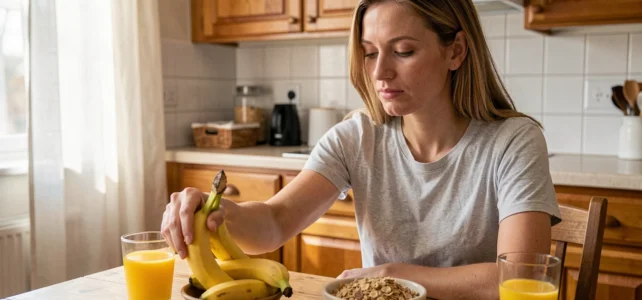
The banana provides an average of about twenty grams of carbohydrates, including a notable proportion of simple sugars. When consumed alone upon waking, on an empty stomach, it triggers a rapid glycemic response that the body struggles to stabilize without additional protein or fat intake. Understanding this mechanism helps determine whether the banana has a place at breakfast, and especially in what form.
Glycemic index of the banana: the decisive role of ripeness
The glycemic index (GI) measures the speed at which a food raises blood glucose levels. For the banana, this figure is not fixed: it varies significantly depending on the ripeness of the fruit.
A slightly green banana contains more resistant starch, a carbohydrate that the small intestine does not fully digest. This starch slows down sugar absorption and limits the glycemic spike. In contrast, a very ripe banana, speckled with brown, has converted almost all of its starch into simple sugars (glucose, fructose, sucrose). Its GI then rises sharply.
Several recent nutritional comparisons highlight that a slightly green banana spares blood sugar levels more than some other fruits commonly consumed in the morning. The problem is that most consumers prefer very ripe bananas, which are sweeter and easier to digest, precisely those whose glycemic profile is least favorable when fasting.
An article details why you shouldn’t eat a banana in the morning by isolating this starch conversion mechanism, which transforms a rather moderate fruit into a source of quick sugar.
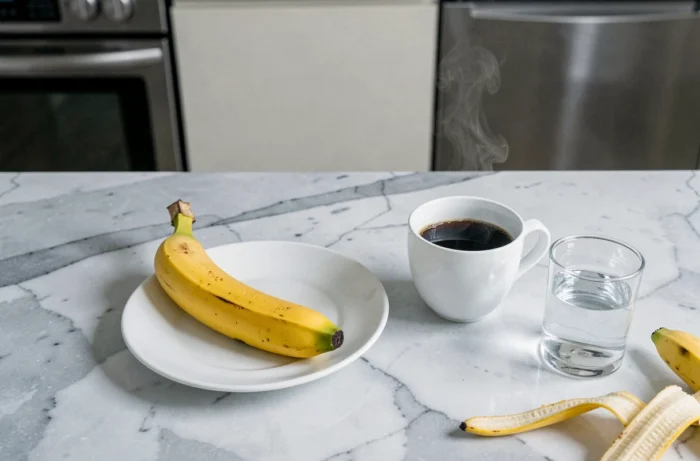
Blood sugar spike on an empty stomach: what happens in the following two hours
Eating a ripe banana alone for breakfast causes a rapid rise in blood glucose. The pancreas then secretes a significant amount of insulin to bring blood sugar levels back to normal. This correction is often excessive.
The result is a phenomenon that nutritionists call reactive hypoglycemia. Specifically, the feeling of hunger returns well before lunchtime, sometimes accompanied by fatigue, difficulty concentrating, or a craving for sweet snacks. The quick energy provided by the banana turns against the metabolic stability of the rest of the morning.
This pattern does not only concern diabetic or prediabetic individuals. In a healthy person, eating a banana alone on an empty stomach produces the same type of glycemic curve, simply with lesser amplitudes. The difference is that a healthy individual compensates more easily, but the feeling of a slump remains noticeable.
Food order at breakfast and glycemic response
A rarely discussed angle in content about bananas in the morning concerns the order in which foods are consumed. Recent studies show that eating fibers and proteins before carbohydrates significantly reduces the post-meal glucose spike.
Applied to breakfast, this principle changes the game. Starting with plain yogurt, some nuts, or eggs, and then finishing with the banana, mitigates the insulin response compared to the reverse order. The fruit arrives in a stomach already lined with fats and proteins that slow gastric emptying.
This approach does not mean banning bananas in the morning, but rather repositioning them at the end of the meal instead of at the beginning. The nuance is significant: the structure of the meal matters more than the presence of an isolated fruit.
Combinations that stabilize morning blood sugar
- Slightly green banana sliced on oatmeal, with a spoonful of almond butter: the fibers from the oats and the fats from the almond slow down sugar absorption.
- Mashed banana on whole grain bread with fresh cheese: the protein from the cheese and the fibers from the whole grain bread lower the overall GI of the meal.
- Banana consumed after scrambled eggs: the proteins and fats from the egg, eaten first, reduce the amplitude of the glycemic spike.

Ripe banana and digestive issues: the FODMAP angle
People suffering from irritable bowel syndrome (IBS) or bacterial overgrowth (SIBO) face an additional problem with bananas at breakfast. So-called “low FODMAP” diets specifically target very ripe bananas, which are high in fructans and free fructose.
These fermentable sugars are poorly absorbed by the small intestine in sensitive individuals. They reach the colon where bacteria ferment them, producing gas, bloating, and discomfort. Consumed in the morning on an empty stomach, the ripe banana exacerbates these symptoms because nothing slows its transit to the colon.
A still firm banana, on the other hand, contains fewer fructans and can remain compatible with a low FODMAP diet. This distinction is clinically documented but rarely mentioned in public nutritional advice, which treats the banana as a homogeneous fruit regardless of its ripeness stage.
When the banana at breakfast remains relevant
The banana is not a bad food. It provides potassium, vitamin B6, and dietary fiber. The issue arises only in a specific context: when consumed alone, very ripe, on an empty stomach.
For athletes training early in the morning, the ripe banana provides quickly mobilizable energy, and the glycemic spike it causes is then utilized by muscular effort. In this case, the mechanism that poses a problem for sedentary individuals becomes an advantage.
For all other profiles, the rule can be summarized in three points:
- Choose a banana that is still slightly firm rather than brown-speckled.
- Never consume it alone: always pair it with a source of protein and fat.
- Place it at the end of the meal rather than at the beginning, to benefit from the buffering effect of other foods.
Breakfast remains a meal whose overall composition determines the energy stability of the morning. Removing the banana does not solve anything if the rest of the meal consists of sugary cereals and fruit juice. The real issue lies in the balance between carbohydrates, proteins, and fats, not in the exclusion of a particular fruit.