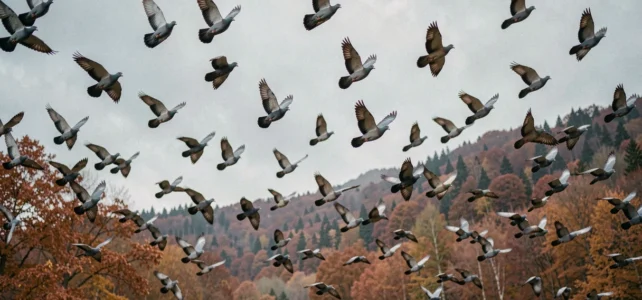
Every autumn, millions of wood pigeons cross France towards the Iberian Peninsula. Observing this migration requires understanding what triggers the flights, choosing the right spot, and knowing how to read changing weather conditions. The 2025 season confirmed some trends and disrupted others.
Read the migration weather before looking up
Most articles on wood pigeon migration merely provide date ranges, from mid-September to late November. These windows exist, but they are not enough to predict a passage. It is the fine weather conditions that trigger the large flights.
Wood pigeons depart en masse when a cold front settles in northern Europe, driven by a north to northwest wind. To anticipate a passage, several parameters must be crossed: atmospheric pressure, wind direction and strength, humidity, cloud cover, and even moon phases.
Specialized modules, like those offered on certain tracking sites, display this data over four to ten days. The idea is simple: when the pressure rises in the north and the wind shifts to the northwest, the birds take off. When the wind shifts to the south or rain sets in, the flights stop and the wood pigeons land.
Have you ever noticed that on certain October mornings, the sky remains empty despite the good season? It is often because the wind is not cooperating. For those who want to follow the migration of wood pigeons on Max Trucs, this day-to-day weather tracking radically changes the quality of observations.

Observation of wood pigeons from the Pyrenean passes and other spots
The choice of observation location is as important as timing. Wood pigeons follow relatively stable air corridors from year to year, dictated by the terrain and prevailing winds.
Why the passes concentrate the flights
When wood pigeons arrive at the Pyrenees, they look for the lowest crossing points. The passes channel the birds in dense flows, sometimes over a few hundred meters wide. This is what makes these spots so spectacular.
Beyond the Pyrenees, other sites offer remarkable views. The ridges exposed to the north and the east-west oriented valleys act like natural funnels. The LPO Occitanie organizes observation camps every autumn at specific sites, conditioned by the northwest wind.
Adapting your position to the day’s wind
A pass is only productive if the wind pushes the birds in its direction. With a west wind, wood pigeons deviate towards the western passes. With a strong north wind, they pass further east. Experienced observers check the weather the night before and choose their spot accordingly, rather than returning to the same place out of habit.
Citizen tracking and real-time data collection
The observation of wood pigeon migration in 2025 benefited from an underestimated tool: structured participatory tracking, which turns every observer into a data collector.
Platforms like palombe.com or faune-france.org allow users to report a passage by specifying the location, time, flight direction, and approximate number of birds. These individual observations, once aggregated, create a near real-time map of the migration.
- Report each flight with a precise time and an estimate of the number of birds, even if approximate, to enrich the collective database.
- Crossing local observations with those from other regions helps identify the migration front and anticipate upcoming passages.
- Associating wood pigeons with other migratory species observed at the same time (cranes, kites, rock pigeons) helps confirm that a migratory wave is underway.
This collective work goes beyond the simple pleasure of observation. End-of-season summaries allow for comparisons between years and help identify gradual shifts in dates or corridors. Feedback from the field in 2025 indicates a generally better season than the previous two in certain regions like Gironde, but with very concentrated passages over a few days.
Wood pigeon migration trends: what 2025 confirmed
Several signals converge. The migration is becoming more unpredictable from year to year, with short and intense waves rather than a flow spread over two months. Observers monitoring the Falsterbo site in Sweden have noted this: massive departures occur over just a few days when conditions align.
Falsterbo acts as an early indicator. When tens of thousands of wood pigeons leave southern Sweden, it takes about a week to ten days before they appear in northern France, depending on wind conditions. This delay allows French observers to prepare.
The other notable trend concerns the influence of agricultural practices. Stopover areas change based on available crops. A freshly harvested cornfield attracts wood pigeons on migratory pause, while a plowed field does not hold them. Identifying fields still covered with stubble near flight corridors significantly increases the chances of ground observation.
The 2025 season also reminded us that mornings remain the most reliable time slot. Wood pigeons take off with the first light of day and benefit from the morning updrafts. In the middle of the day, flights become rarer, except during very large waves when the passage can last until early afternoon.
Observing the migration of wood pigeons is not just about being in the right place at the right time. It is an exercise in reading the sky, the wind, and the agricultural landscape, supported by data shared among enthusiasts. Those who combine local weather, participatory tracking, and knowledge of the terrain have a head start every autumn.