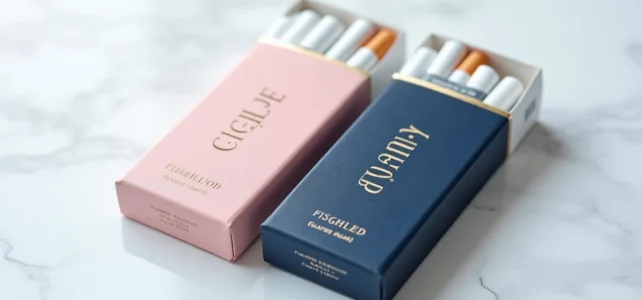
In the French tobacco market, the Vogue range offers several pack colors, each corresponding to a distinct technical profile. The pastel and blue Vogue cigarettes share the same super-slim format, but their composition sheets reveal measurable differences in nicotine, tar, and carbon monoxide. Understanding these differences allows for a deeper insight beyond the subjective feelings of “smoothness” or “strength” often mentioned by smokers.
Tar and nicotine levels: what the distributor sheets indicate about the blue Vogue
Articles comparing Vogue variants often limit themselves to qualitative descriptions. European distributor sheets provide more precise data. According to information available on Tabakstore.de, a super-slim blue Vogue displays 0.7 mg of nicotine and 8 mg of condensate per cigarette, with 8 mg of carbon monoxide.
On Tabakland.de, another reference for blue Vogue is described with slightly different values depending on the measurement standard applied: 6 mg of tar, 0.6 mg of nicotine, and 4 mg of CO. These discrepancies between sheets can be explained by testing protocols (ISO standard or DIN standard) and by the sub-references that coexist within the blue range.
In comparison, the lilac Vogue, a lighter variant often associated with the pastel, shows only 0.4 mg of nicotine and 4 mg of condensate according to the same source. The difference is significant: the blue delivers almost double the nicotine and tar compared to its lighter neighbor. This point clarifies the differences between pastel and blue Vogue cigarettes well beyond mere color coding.
Vogue filter ventilation: the mechanism that separates pastel and blue
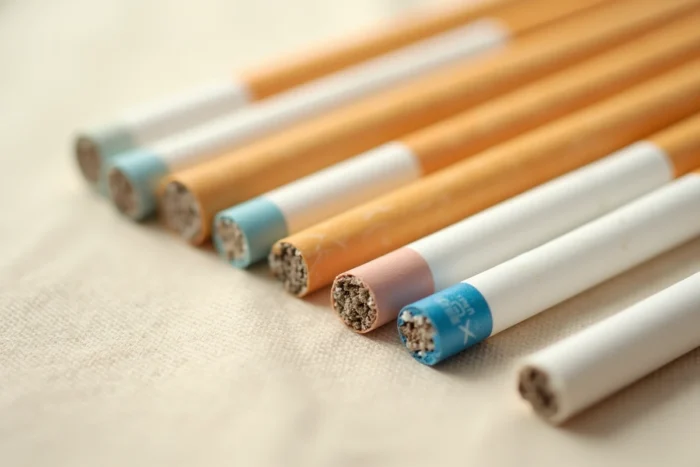
The color of the pack primarily signals a filter ventilation rate. The filter of Vogue cigarettes features micro-perforations arranged in a ring, invisible to the naked eye. These perforations allow ambient air to enter, diluting the smoke before it reaches the smoker’s mouth.
On a pastel or lilac variant, the number and diameter of these perforations are higher. The airflow entering through the filter represents a larger proportion of the inhaled volume. The smoker then perceives a lighter, less harsh smoke, with a muted throat hit.
On the blue Vogue, ventilation is more limited. Less ambient air mixes with the smoke, increasing the concentration of particles and nicotine in each puff. The draw is more resistant, the smoke denser, and the throat sensation more pronounced.
Respiratory compensation and false lightness
A well-documented phenomenon in tobacco literature nuances this mechanism. Smokers who switch to a more ventilated cigarette tend to pull harder or unconsciously block the filter perforations with their fingers or lips. This compensatory reflex partially negates the dilution effect.
The values measured in the laboratory (tar, nicotine, CO) are obtained by machines that do not compensate. The actual exposure of the smoker may therefore be higher than what the technical sheets suggest, whether the cigarette is blue or pastel.
Blend composition: Virginia tobacco and assembly of Vogue variants
The lighter variants of the Vogue range (pastel, lilac, white) favor a higher proportion of flue-cured Virginia tobaccos. This hot air drying preserves more natural sugars in the leaf, producing smoke perceived as smoother and slightly sweet from the moment of lighting.
The blue Vogue incorporates a different blend, with a larger share of air-cured tobaccos, which bring bitterness and a more pronounced note. The super-slim format remains common to all variants, meaning that the total amount of tobacco per cigarette is identical, only the recipe of the blend changes.
- Vogue pastel/lilac: dominant flue-cured Virginia, smooth smoke, light sweetness, low throat hit
- Vogue blue: blend of Virginia and air-cured tobaccos, denser smoke, more pronounced bitterness, moderate to strong hit
- Vogue white: maximum ventilation, the lightest profile in the range, but very frequent respiratory compensation among regular smokers
Price and positioning in the French tobacco market
The price of a pack of Vogue cigarettes has followed the general upward trend in France in recent years. The available data does not confirm a stable price gap between the pastel and blue variants in the French market, where the price is set by reference within the same manufacturer.
However, some occasional price drops have been observed on other brands within the group. Winston, for example, experienced a reduction in March 2024. These pricing adjustments sometimes alter the relative positioning of Vogue compared to competing brands in the slim and super-slim segment.
The super-slim format of Vogue historically targets an audience that associates the fine design with an image of sophistication. The choice between pastel and blue is as much about the desired flavor profile as it is about the marketing positioning of each sub-reference.
Additives and regulatory framework
European regulation governs the additives permitted in cigarettes. Characterizing flavors (menthol, vanilla, fruits) have been banned since 2020 in the European Union. The taste differences between pastel and blue Vogue therefore rely on:
- The type of tobacco used in the blend and its drying method
- The filter ventilation rate, which alters perception without changing the tobacco composition
- The non-characterizing residual additives (humectants, combustion agents), common to most industrial cigarettes
The data available on distributor sheets do not detail the complete list of additives by Vogue variant. No variant presents a reduced risk profile compared to another, despite the differences in perception. The slim format and pastel colors contribute to a perception of lower harm that is not supported by current health data.