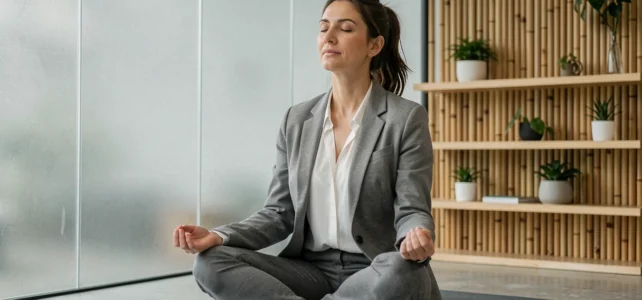
An employee who sits for eight hours in front of a screen does not experience the same tensions as a maintenance technician who stands all day. Workplace wellness services become more relevant when they start from this simple reality: each position generates specific physical and mental constraints. Offering solutions tailored to these constraints, rather than a generic activity, changes the game for work-life balance.
Wellness workshops tailored to workplace constraints
Have you ever noticed that neck pain affects different profiles than lower back pain? A traveling salesperson uses their shoulders and back differently than a software developer. The most relevant providers build their interventions based on this observation.
Specifically, this means that a workshop aimed at an administrative team will focus on prolonged sitting: hip mobility, trapezius relaxation, eye exercises. For a logistics team, the approach will address repetitive movements and the prevention of musculoskeletal disorders. This job-specific customization remains largely invisible in most consumer offerings, even though it conditions the actual effectiveness of the program.
Among the services offered by Tendance Équilibre, this logic of adaptation to professional realities is evident, with formats designed to integrate into the work rhythm without disrupting the day.
Micro-practices integrated into the day: the alternative to one-off events
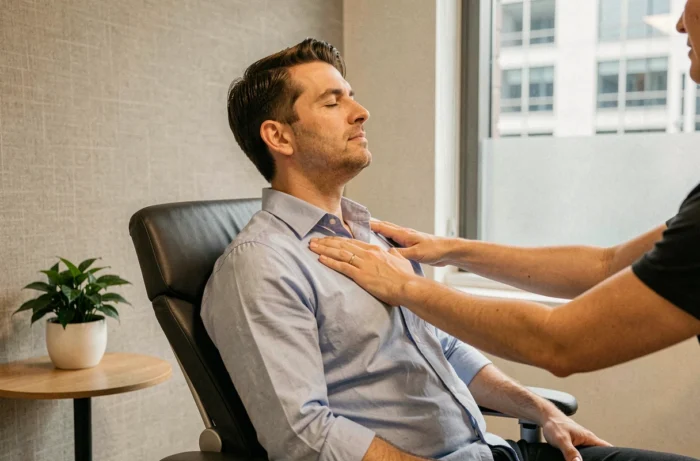
An annual wellness day creates a pleasant moment. It does not permanently change a team’s habits. What produces measurable results on stress and fatigue are micro-practices repeated several times a week.
What exactly are we talking about? Short sequences, between three and ten minutes, integrated into the actual workflow:
- A five-minute guided breathing session before a meeting to refocus the team’s attention
- An active break between two focused work slots, with movements targeting tension areas related to the position
- A “reset” ritual at the end of the morning, combining stretching and mental relaxation, to cut the gradual rise of stress
These short formats address a constraint that employees often express: the lack of time remains the primary barrier to practicing wellness at work. Offering an hour of yoga at 12:30 excludes those who are having lunch with a client or managing a tight schedule. Three minutes of joint mobility at 10:00, on the other hand, requires no reorganization.
How to anchor these practices over time
The classic trap: launching a micro-practice program with enthusiasm, only to see participation collapse after three weeks. To avoid this, some programs rely on an internal relay. An employee trained in the basics of wellness facilitation can lead these short sequences without depending on an external facilitator for each session.
Training a wellness referent for each team sustains the program well beyond the initial service. This relay does not need to be an expert: they follow a simple protocol, adapted to the needs identified during the initial assessment.
Prevention of psychosocial risks: the framework that gives meaning to wellness
Wellness at work is not just about comfort. It falls within a specific regulatory framework. Each company must assess psychosocial risks and integrate them into its single document for professional risk assessment (DUERP). Without this foundation, wellness workshops remain isolated actions, disconnected from a prevention strategy.
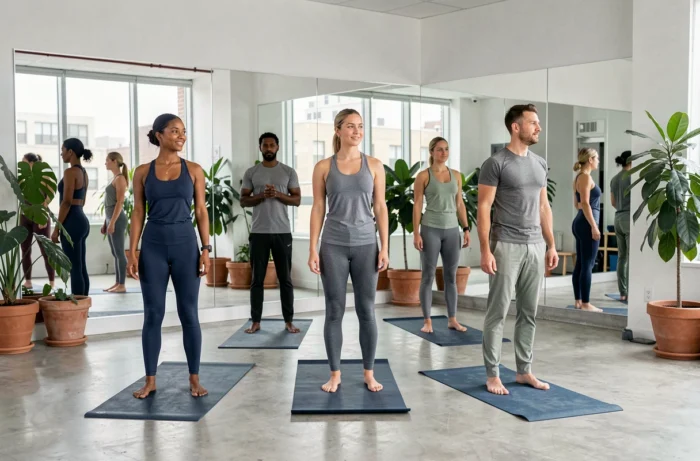
Why does this point matter so much? Because a stress management workshop loses its credibility if, at the same time, the workload remains unbearable or if managers have not received any training on warning signals. Wellness works when it is aligned with the company’s overall health policy.
Listening spaces and psychological support
Several recent programs combine group workshops with individual access to mental health professionals. The principle: an employee who identifies discomfort during a group workshop can then consult a psychologist, often via a digital platform, in a confidential setting.
This hybrid model (in-person for the group, digital for the individual) adapts particularly well to dispersed or remote teams. It avoids the pitfall of a wellness program reserved only for employees present on-site.
Hybrid formats for remote and on-site teams
The generalization of hybrid work has rendered exclusively in-person wellness programs obsolete. A professional wellness service must cover remote employees with the same quality as in-person.
The formats that work in this context share some common characteristics:
- Short videoconference sessions (twenty to thirty minutes), scheduled during time slots compatible with the team’s time zones
- Asynchronous content (videos, audio relaxation guides) accessible at any time on a dedicated platform
- Regular follow-up via anonymous listening tools that allow adjusting the program to real needs, not assumptions
This last point deserves attention. Many companies choose their wellness workshops from a catalog, without consulting employees. Surveying teams before selecting a format prevents offering yoga to people who need psychological support, or vice versa.
Evaluating impact beyond immediate satisfaction
A post-workshop satisfaction questionnaire measures immediate feelings. It says nothing about the evolution of stress, absenteeism, or quality of life at work over several months. Structured programs integrate follow-up indicators: frequency of use of the tools provided, changes in reports of discomfort, feedback from managers trained in detecting psychosocial risks.
Work-life balance is not decreed during a themed day. It is built through regular actions, calibrated to the real constraints of each team, and anchored in a prevention approach that goes beyond simple activities. Companies that achieve sustainable results are those that treat wellness as a continuous process, not as an event.