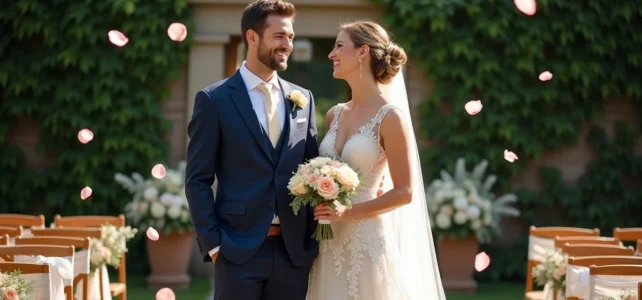
Organizing a wedding typically involves around ten service providers, a reception venue, and several months of preparation. Between the budget, the choice of format, and the coordination on the big day, every decision made in advance shapes the experience for the couple and their guests. Comparing expense categories and celebration formats helps establish a solid foundation before committing to the first service providers.
Classic wedding or intimate wedding: how the format affects the budget
The number of guests remains the primary budget lever. A wedding with around a hundred guests and an intimate wedding (fewer than thirty people) do not require the same categories of expenses, nor in the same proportions.
| Expense Category | Classic Wedding (80-120 guests) | Intimate Wedding (15-30 guests) |
|---|---|---|
| Reception Venue | Estate, castle, reception hall with large capacity | Cottage, private restaurant, villa with on-site accommodation |
| Catering / Meals | Heaviest expense, often half of the total budget | Gourmet meal possible, higher unit cost but overall budget reduced |
| Floral Decoration | Large volume (tables, ceremony, entrance) | Reduced arrangements, budget divided |
| Entertainment / DJ | DJ or band for several hours of the evening | Personalized playlist or acoustic musician |
| Photography / Video | Complete coverage of the day | Shorter coverage, sometimes complemented by a narrative film |
| Stationery (invitations, menus, seating plan) | Significant printing, multiple formats | Limited printing, extensive customization |
The intimate format allows reallocating part of the budget towards the quality of the experience: collective accommodation, multi-course meals, extended ceremony time. This is the principle of slow wedding, which prioritizes the pace and connection among guests rather than an overload of entertainment.
By browsing the advice from Mariage et Vous, one realizes how the trade-off between the number of guests and the quality of each category structures the entire organization process.
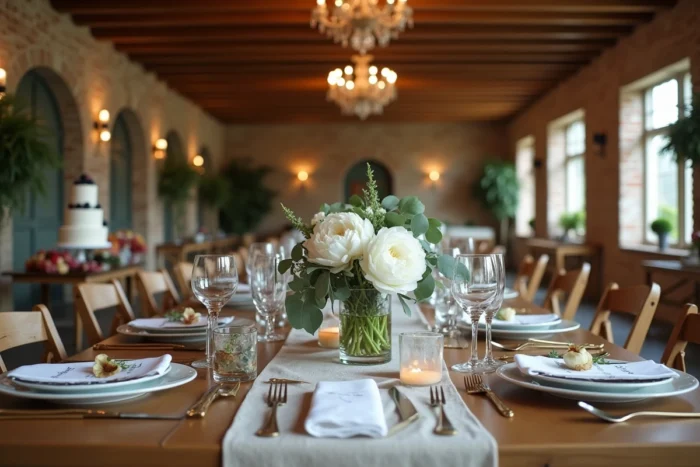
Wedding budget breakdown: the categories that really matter
The caterer absorbs the largest share of the overall wedding budget. The reception venue and photography follow, but the differences vary significantly based on the couple’s choices.
Caterer and reception venue: the two categories to prioritize first
The caterer often represents half of the total budget for a classic wedding. This category evolves proportionally to the number of guests, which explains its dominant weight. The reception venue, on the other hand, functions more like a fixed cost: an estate charges a rental fee regardless of the number of guests (within its capacity limits).
Booking the venue and caterer as a priority, ideally a year before the date, secures the two most structuring categories. The most sought-after service providers fill up quickly, especially for summer weddings.
Secondary categories: decoration, attire, entertainment
Floral decoration, the couple’s attire, DJ or musicians, and stationery make up the rest of the budget. Each of these categories offers a wider margin for maneuver.
- Floral decoration can be streamlined by choosing seasonal flowers and reusing the ceremony arrangements for the reception.
- The attire (wedding dress, suit) represents a variable personal investment, decoupled from the number of guests.
- Entertainment (DJ, photobooth, musician) can be adapted to the format: an intimate wedding can easily do without a full orchestra.
Allowing a margin for unexpected expenses remains a useful reflex. Last-minute adjustments to decoration, transportation, or guest accommodation almost always arise.
Coordination on the big day: the rhythm of the day as a success factor
Competitors often detail the preparation steps in advance (planning, lists, invitations). A less covered aspect concerns the management of the rhythm on the day itself, which nevertheless determines the overall feeling of the couple and their guests.
The classic pitfall: chaining the ceremony, cocktail, group photos, dinner, and evening without any breaks. The couple finds themselves constantly solicited and has no moment for themselves or to truly connect with their loved ones.
Planning intentional downtime between key moments
Leaving thirty to forty-five minute slots between the ceremony and the cocktail, or between dessert and the first dance, changes the experience. These breaks allow the couple to breathe, guests to move without haste, and the photographer to capture spontaneous moments rather than posed ones.
Each service provider receives a detailed roadmap with schedules, contacts, and any dietary requirements. This coordination avoids confusion and misunderstandings on the big day.

Service provider roadmap: elements to include
- Precise timings for each key moment (ceremony, cocktail, dinner, entertainment, end of the evening).
- Contact details of a point person on-site (never the couple themselves) to manage logistical questions.
- Access plan to the venue, parking instructions, and supplier access.
- Seating plan with mentions of specific dietary requirements, sent to the caterer at least two weeks in advance.
A wedding planner can ensure this coordination, but an organized friend equipped with the roadmap can also fulfill this role for small weddings.
Slow wedding trend: a format choice, not just a fad
The slow wedding is not just about reducing the number of guests. It is a deliberate choice regarding the overall pace of the celebration: longer and personalized ceremony, multi-course meals with local products, refusal to fill every minute with entertainment.
Recent reports, notably that of the intimate wedding of Mathilde and Renaud in Minorca published by Madame Figaro, illustrate this approach where the setting, shared time, and culinary quality take precedence over spectacle. The trend goes beyond the post-Covid phenomenon to establish itself as a full-fledged format.
This format particularly suits couples who want a wedding focused on experience rather than logistics. The budget freed up by reducing the number of guests is reinvested in the venue (often with collective accommodation), the meal, and photography.
The choice between a classic wedding and an intimate format primarily depends on the priority given to the number of close ones present or the quality of each shared moment. The comparative table at the beginning of the article summarizes the concrete differences between these two approaches. Regardless of the option chosen, booking the venue and caterer at least a year in advance remains the first concrete step towards a well-managed organization.