
When bringing a newborn home, the first instinct is often to buy everything. Crib, bouncer, bathtub, stroller, play mat: the list seems endless. However, the essential equipment for the baby’s comfort can be summarized in a few well-chosen items, provided you distinguish what is truly useful on a daily basis from what will end up in the garage after three weeks.
Swaddles and versatile textiles: the underestimated essentials
We rarely think of the swaddle first. Yet, it is the accessory that comes in handy most often during an ordinary day with an infant.
A swaddle serves as a light wrap, an extra blanket on the bouncer, a changing pad cover, a nursing cover, or an improvised bath towel. Having six to twelve swaddles prevents urgent laundry and covers all daily uses without multiplying purchases.
For textiles in prolonged contact with the skin (sleep sacks, sheets, swaddles), check for GOTS or Oeko-Tex certification. These labels guarantee the absence of harmful substances in the fibers and dyes, a criterion that has become central in recent comparisons. You can find the equipment on Niddou to quickly identify the references that meet these requirements.

Baby play mat: a play surface above all
The play mat is often presented as a toy. In practice, its primary function is to provide a safe play surface on the floor, thick enough to insulate from the cold and firm enough not to hinder free movement.
Recent recommendations emphasize three concrete points:
- A non-slip bottom, to prevent the mat from sliding on tiles or hardwood when the baby starts pushing with their legs.
- Certified materials (Oeko-Tex at a minimum), especially for foams that may release volatile compounds in a closed space.
- The absence of use as a sleeping place, even if the mat is equipped with arches and hanging toys. A baby who falls asleep on their play mat should be moved to their crib.
Models with removable arches offer more flexibility. You can remove the arch for tummy time and put it back on for observation phases. A simple, well-chosen mat effectively replaces three separately purchased developmental toys.
Infant sleeping and rest: what really matters
The sleep category captures attention (and budget). Between the co-sleeping cradle, the convertible crib, and the bassinet, options abound. The initial constraint is simple: a firm mattress, exactly fitting the crib, with no gaps between the edge and the frame.
A cradle is used during the first months, after which you need to switch to a crib. If the budget is tight, starting directly with a 60×120 crib with an appropriate reducer avoids an intermediate purchase. Feedback varies on this point, with some parents finding the cradle more reassuring for the first weeks.
The sleep sack replaces the blanket. You choose the thickness (expressed in TOG) based on the room temperature. A light sleep sack for summer, a thicker one for winter, and a reliable room thermometer: this trio covers nearly all situations.
What can be postponed or rented
The travel crib, the travel bouncer, the electric swing: these items are useful for only a few months at best. The rental of baby equipment has developed in recent years, with local services specifically targeting equipment used for a short period. Renting a travel crib for vacations or a bouncer for two months reduces both budget and clutter.
Carrying and transportation: choose based on actual use
You don’t use a stroller the same way in the city as in rural areas. Before investing, identify your primary use: short walks, public transport, forest outings, or a mix of the three.
For the first few weeks, a physiological baby carrier (or a wrap) is often sufficient for short trips. Carrying frees up your hands, reassures the infant through contact, and avoids taking out the stroller just to get some bread.
The stroller becomes useful when outings extend, usually after the first month. Opt for a model compatible with a carrycot or car seat for mixed car-walk trips. The group 0+ car seat is not optional: it is a legal requirement as soon as you leave the maternity ward.
Bathing and changing: the effective minimum
A small rigid bathtub, a fragrance-free moisturizing soap, a cotton hooded towel: the bathing essentials can be summed up in three items. Bath thermometers remain useful until you have the elbow reflex to check the temperature.
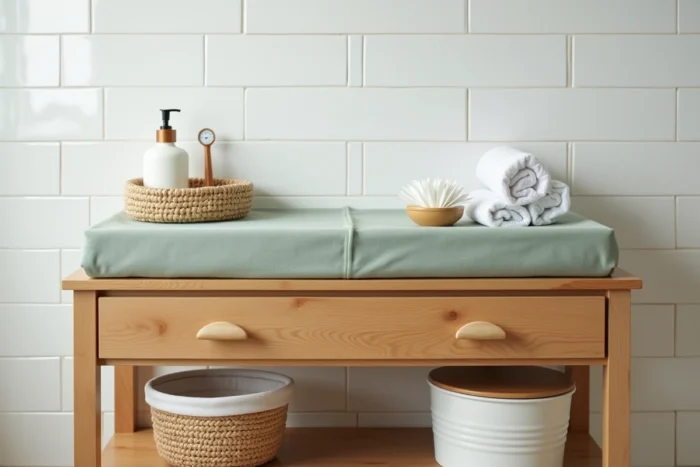
For changing, the main item is the changing table (or a changing pad placed on a dresser). You should add:
- Sufficient diapers to last several days, disposable or washable depending on family logistics.
- Liniment or water wipes, avoiding scented products on infant skin.
- A removable and washable changing mat, more hygienic than a model covered with a towel.
The stock of diapers represents the highest recurring expense in the first year. Parents who are unsure between disposables and washables can test both systems for a few weeks before making a decision.
The most reliable approach remains to start with the strict essentials, then add equipment when a concrete need arises. A comfortable baby sleeps better, eats better, and so do their parents.