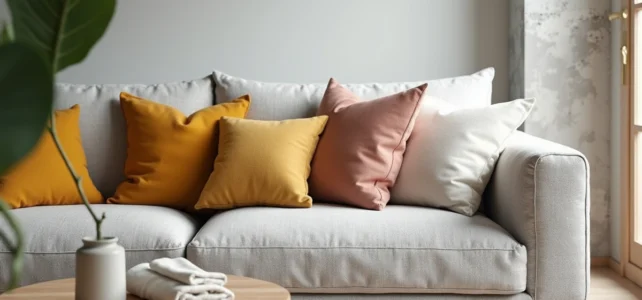
The gray sofa remains one of the most common bases in French living rooms. Its neutrality facilitates combinations, but it poses a concrete problem: without well-chosen cushions, the whole ensemble appears flat or too monochrome. The choice of cushions depends less on abstract personal taste than on measurable parameters such as the temperature of the gray, the brightness of the room, and the nature of the textiles already present.
Temperature of Gray and Color Reactions to Light
Not all grays are created equal. A cool gray, leaning towards blue, absorbs light differently than a warm gray close to taupe. This factor conditions the entire choice of cushions, and most decor guides dismiss it in a single sentence.
A bluish gray exposed to cold natural light (north orientation) accentuates the feeling of coldness. Adding navy blue or charcoal gray cushions without a warm counterpoint creates a visually dull living room. In contrast, the same cool gray in a southwest-facing room tolerates deep tones well, because the warm daylight naturally compensates.
Before selecting a palette, it is essential to observe the sofa at several times of the day. A terracotta cushion that seems perfect in the late afternoon may appear garish under white LED lighting in the evening. This test, which costs nothing, prevents unnecessary returns. To harmonize cushions with a gray sofa, this step of light verification makes all the difference.
Natural Fiber Cushions on Gray Sofa: A Decisive Criterion
The interior design market is driven by a growing preference for sustainable materials, including eco-friendly textiles and recycled fibers. This movement is significantly changing what is available on the shelves and what buyers are looking for.
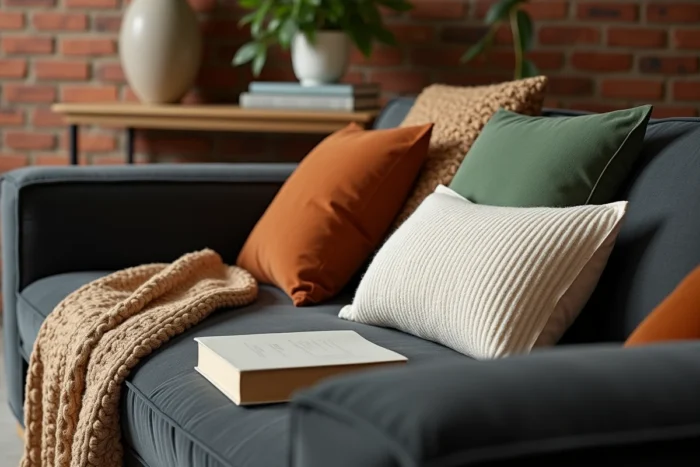
For a gray sofa, this translates into broader access to cushions made of linen, organic cotton, or wool. These materials offer a direct decorative advantage: their irregular texture breaks the monotony of a sofa fabric that is often smooth and uniform. A crumpled ecru linen cushion on an anthracite gray creates a surface contrast that polyester cannot replicate.
This trend aligns with the biophilic logic that connects cushions to nature. The associated shades (sage green, khaki, terracotta, ecru) particularly harmonize with warm grays. On a taupe gray, a khaki wool cushion and another in sandy linen create an organic atmosphere without forcing the color.
Structured Palette for Gray Sofa: Two Depths Method
The 2025-2026 trend favors a two-level composition on the gray sofa:
- A base of textured cushions in beige or sandy tones, which brings a cocooning effect and softens the gray without masking it.
- Some cushions in deep shades (forest green, midnight blue, charcoal gray) that visually anchor the sofa and structure the decor.
- An optional “accent” cushion, in a brighter color like terracotta or mustard yellow, limited to a single piece to avoid overload.
This two-depth method avoids the trap of a dull monochrome as well as that of chaotic mixing. The principle is simple: light cushions occupy the ends of the sofa, dark ones are placed in the center or slightly offset, and the accent remains isolated.
On a pearl gray sofa, the sandy base almost blends with the seat. It is then the deep cushions that create the contrast. Conversely, on an anthracite gray, the beige base stands out clearly, and the dark cushions play a tonal reminder role rather than a contrasting one.
Textures and Patterns on Gray Sofa: Technical Mistakes to Know
Velvet is the decorative textile most associated with living room cushions. On a gray sofa made of textured fabric, a smooth velvet cushion creates an interesting material contrast. However, on a gray velvet sofa, adding other velvet cushions results in tactile saturation that quickly becomes tiresome.
The operational rule is to never double the dominant material of the sofa in the cushions. If the sofa is made of boucle fabric, choose velvet or linen, not boucle. If the sofa is gray leather, cushions made of soft, textured materials (knitted wool, waffle cotton) work better than smooth surfaces that slide.
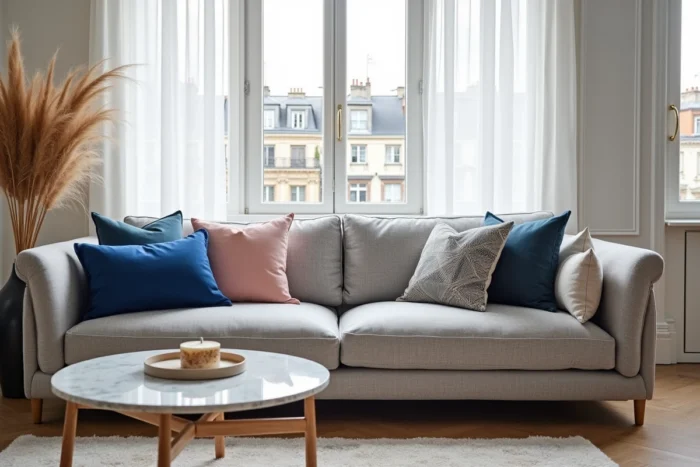
For patterns, the constraint is to not exceed two types across the entire sofa. A geometric pattern and an organic pattern (foliage, irregular stripes) can coexist correctly, provided they share at least one common color. Three different patterns on the same gray sofa create visual noise that even a coherent palette cannot remedy.
Number and Size of Cushions According to the Length of the Gray Sofa
Proportion remains the most neglected parameter. A two-seater sofa can hardly support more than three or four cushions without becoming impractical. A corner sofa, with a longer seat, can accommodate five to seven.
- Two-seater sofa: two standard-sized cushions (about 45×45 cm) and one rectangular lumbar cushion are sufficient.
- Three-seater sofa: four to five cushions, alternating a square format and a rectangular format to break symmetry.
- Corner sofa: five to seven cushions, varying sizes and concentrating deep colors in the corner to visually anchor it.
A cushion that is too small on a large gray sofa visually disappears. Sizes smaller than 40 cm on each side work on armchairs, not on wide seats. The cushion should cover at least one-third of the height of the backrest to appear proportionate.
The number of decorative cushions should also leave room to sit. If removing three cushions before sitting becomes a daily reflex, the composition is unbalanced, regardless of its aesthetic rendering.
The gray sofa offers real latitude in terms of decoration, but each cushion choice benefits from being tested in the lighting conditions of the living room, with the materials already in place. Current trends lean towards natural fibers, two-level depth palettes, and sobriety in the number of patterns. These technical guidelines are worth more than a list of trendy colors that will change in six months.