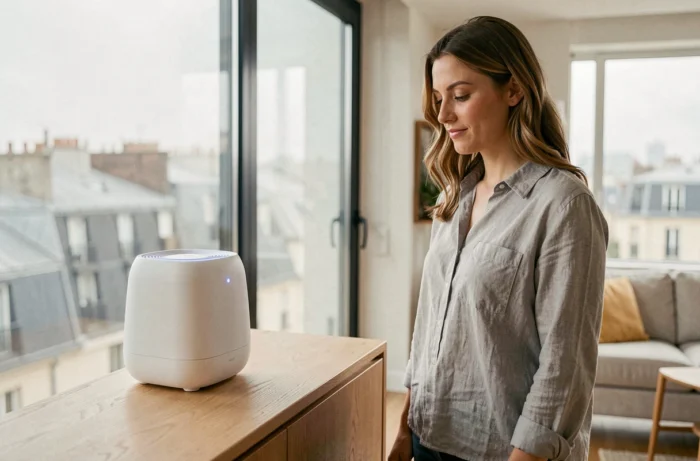
In a city apartment, indoor air contains a mix of fine particles, volatile organic compounds, and dust that natural ventilation does not always manage to eliminate. Among the available technologies, air ionizers are gaining increasing interest. Their principle seems simple: electrically charge suspended particles to make them fall. However, the technical reality deserves some clarifications before investing.
Ionization and HEPA filtration: two different treatment logics
A HEPA filter physically captures particles in a mesh of fibers. Once trapped, they remain in the filter until it is replaced. The ionizer, on the other hand, works differently: it emits negative ions that attach to suspended particles, weigh them down, and cause them to settle on nearby surfaces (walls, furniture, floor).
Do you see the nuance? Ionized particles do not disappear; they change location. A sweep or a draft can put them back into circulation. ADEME indicates that the reduction of PM2.5 varies by model and that efficiency decreases significantly as you move away from the device.
For an urban apartment where pollutants enter through windows and vents, this difference matters. An ionizer alone does not replace a HEPA filter purifier if the goal is to sustainably remove fine particles from the air you breathe. However, some devices combine both technologies, which can represent a relevant compromise. As detailed in the Ionizers guide for apartments, the combination of ionization plus filter improves the overall efficiency of the device.

Ozone emissions: the safety criterion to check first
Ozone is an irritant gas for the respiratory tract. It can worsen symptoms in asthmatic or sensitive individuals. The problem is that ionizers can produce ozone as a byproduct, even when they are not marketed as ozone generators.
ANSES warns about processes that can degrade indoor air quality by producing secondary compounds. An ionizer that releases ozone in a small poorly ventilated apartment becomes counterproductive: it pollutes more than it purifies.
How to ensure a model is reliable in this regard
The “zero ozone” certification is the most verifiable benchmark at the time of purchase. Look for an explicit mention in the technical sheet or on the packaging. An ionizer without documented ozone certification should not be included in your selection.
Some manufacturers display test results conducted by independent laboratories. These documents are worth more than a simple marketing mention on the box. In the absence of any data, move on to the next model.
Concrete criteria for choosing an ionizer suitable for an urban apartment
Buying guides often list about ten criteria. In practice, for use in a city apartment, three parameters make a daily difference.
- The effective covered area: manufacturers often announce a maximum area measured under ideal conditions. In a partitioned apartment, with corridors and doors, the actual range decreases. Prefer a device whose announced area exceeds that of the room where you plan to install it.
- The noise level in continuous mode: an ionizer running at night in a bedroom must remain discreet. Compare the decibels announced in minimal mode, not in maximal mode. A silent device at low speed but noisy in normal operation will quickly be turned off, making it useless.
- The annual maintenance cost: a pure ionizer (without a filter) does not require consumables, but its performance remains limited. A hybrid model combining ionization and HEPA filter involves regular filter replacement. Inquire about the availability and price of replacement filters before purchasing.
The question of electricity consumption
An ionizer generally consumes little. For a device that operates continuously, the difference on the annual bill remains modest compared to a radiator or air conditioner. This criterion should not be decisive in your choice, unless you are comparing two models that are very close on all other points.
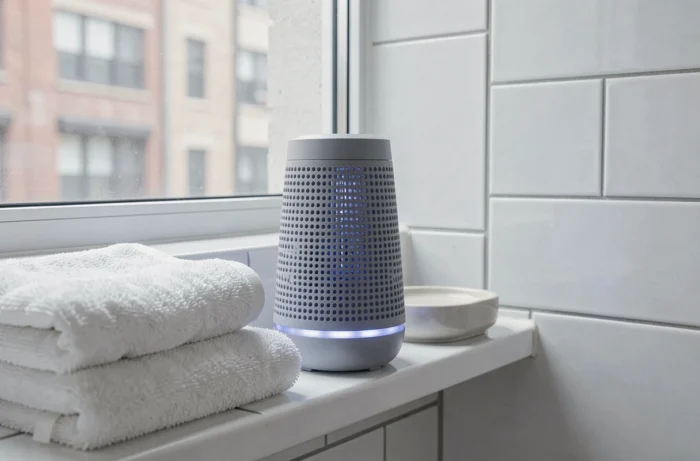
Air ionizer in the city: what ANSES recommends before any purchase
ANSES does not consider the effectiveness and safety of ionization to be demonstrated under real use conditions. Its primary recommendation remains to limit emissions at the source, ventilate regularly, and maintain proper ventilation.
Specifically, for a city apartment, this means that an air ionizer does not compensate for inadequate ventilation. If your mechanical ventilation system is clogged or absent, no device will solve the problem. The ionizer acts as a complement, not as a standalone solution.
Ventilate despite outdoor pollution
Do you live near a busy road and hesitate to open the windows? Outdoor pollution can indeed enter. Ventilating early in the morning or late in the evening, when traffic decreases, remains the simplest practice to renew the air without overloading the interior with particles. The ionizer can then treat the residual pollutants, provided it is properly sized for the room.
Ionizer alone or hybrid purifier: which device for which need
If you suffer from allergies or live with an asthmatic, a HEPA filter purifier is more suitable than an ionizer alone. Mechanical filtration captures allergens (pollen, dust mites, pet hair) in a verifiable manner, whereas ionization displaces them without a guarantee of elimination.
A hybrid device that combines ionization and HEPA filter represents an interesting technical compromise. Ionization clumps the finest particles, making them easier to capture by the filter. This type of model is particularly suitable for apartments exposed to mixed urban pollution (fine particles, odors, volatile compounds).
For a studio or a one-bedroom apartment without specific respiratory issues, a compact ionizer may suffice as a supplement, provided you check for the absence of ozone emissions and maintain regular ventilation. Beyond this area, or in the presence of respiratory sensitivities, the HEPA filter provides a guarantee that ionization alone does not offer.