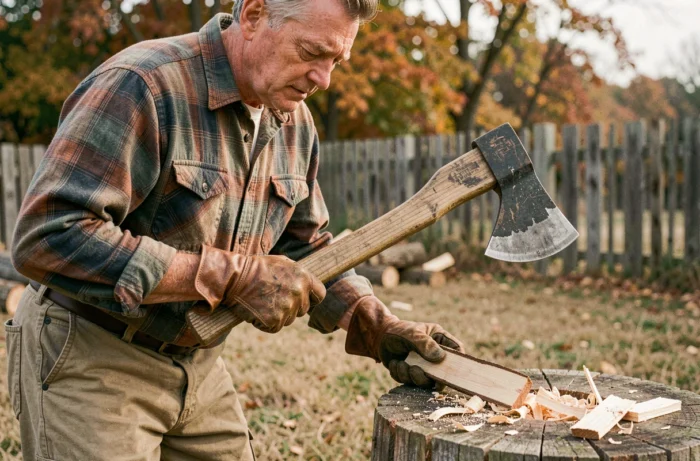
Splitting a log, pruning a low branch, cutting small wood for a stove: the axe remains the most direct tool for these tasks. The choice of the right model depends less on the brand than on the suitability between the type of head, the length of the handle, and the frequency of use. If poorly chosen, an axe can strain the wrist, damage the fibers of the wood, and end up at the back of the garage after two seasons.
Wooden handle or composite handle: what the material really changes
Most guides compare handles made of hickory, ash, and fiberglass without specifying the concrete impact on a prolonged work session. Hickory absorbs some of the vibrations with each impact, which reduces forearm fatigue when splitting wood for more than an hour. Ash offers a similar performance, generally at a lower cost.
Composite handles (fiberglass, reinforced polypropylene) resist moisture better and are less likely to crack if left outside in the rain. However, they transmit more vibrations. For occasional use, a few sessions per season, this difference remains barely noticeable.
A wooden handle requires regular maintenance against moisture. Recent tests published by Mon Poêle Tendance emphasize the need to protect the handle with linseed oil and to store the tool with a sheath. Without this precaution, the durability claimed by manufacturers loses all relevance.
Before making a decision, it may be useful to choose an axe on Ta Maison Ton Jardin to compare the types of handles available according to their uses.
Splitting axe, hatchet, maul: which type of axe for which job in the garden
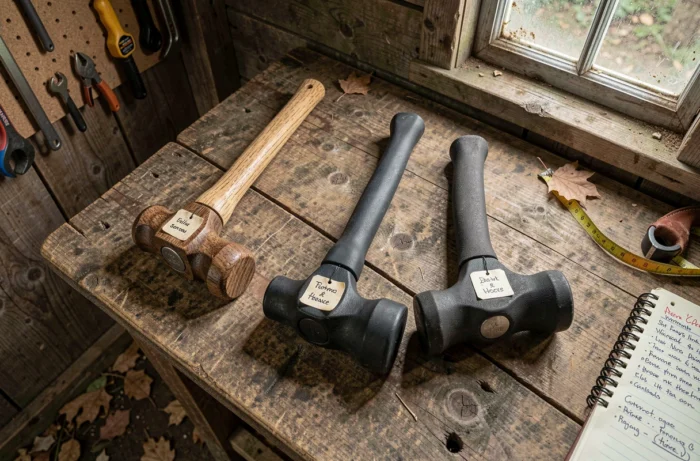
The vocabulary around axes can be confusing. Three categories cover almost all the needs of an individual maintaining their garden and preparing their firewood.
- The hatchet (short handle, light head) is used for pruning small diameter branches, trimming stakes, or preparing kindling. Its compactness makes it easy to handle with one hand, but it lacks the power to split thick logs.
- The splitting axe has a heavier head and a wedge-shaped edge. It is designed to separate the fibers of the wood lengthwise. User feedback on the Hultafors Waldaxt Premium indicates that this type of model is aimed at people who split wood regularly: its price and maintenance are hard to justify for just a few uses per year.
- The maul combines a hatchet head on one side and a mass on the other. It allows for splitting and driving wedges without changing tools. Its high weight is reserved for intensive splitting sessions.
For a medium-sized garden with a wood stove used occasionally, a hatchet and a mid-weight splitting axe cover most situations.
Head weight and handle length: the combination that determines efficiency
Many buyers choose an axe based on its appearance or brand. The most reliable criterion remains the ratio between the weight of the head and the length of the handle, as this combination determines the impact force and the precision of the action.
A long handle amplifies force but requires a clear workspace. If you are splitting wood in a cluttered garden, near a fence, or under a low overhang, a handle that is too long becomes a risk. Conversely, a short handle with a heavy head requires compensating with muscle strength, which accelerates fatigue.
Field feedback varies on the ideal head weight for versatile use. Manufacturers offer ranges from a few hundred grams for a hatchet to several kilograms for a maul. A pragmatic guideline: if the axe feels too heavy when held at arm’s length for a few seconds, it will feel even heavier after twenty minutes of splitting.
The edge profile changes the game
A fine and narrow edge penetrates well into green or soft wood but can easily get stuck in knotty logs. A thick, convex wedge-shaped edge splits the log without getting stuck. For standard firewood, the convex profile is more suitable than the fine blade.
Regular sharpening of the edge with a suitable stone or file maintains cutting efficiency. A dull blade requires harder strikes, which wears out the handle and increases the risk of deviation.
Safety and storage: two angles that product sheets do not address
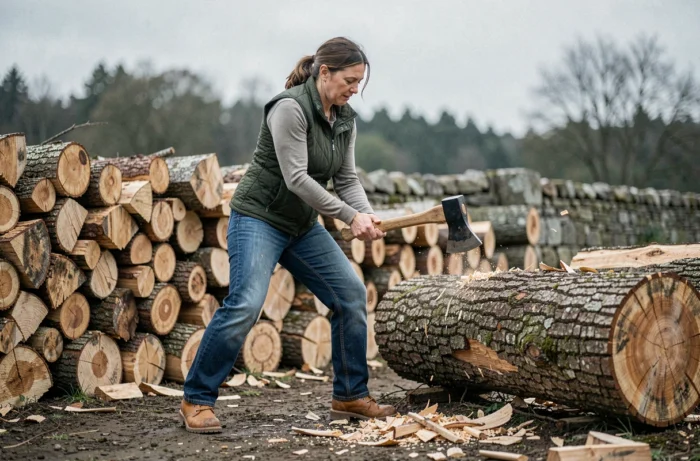
Product sheets detail the steel, weight, finish, but rarely mention storage conditions and usage precautions. A protective sheath for the blade is not an accessory, it is a necessity. Without a sheath, the edge dulls from contact with other tools in a trunk or garden shed, and the risk of cuts during handling increases.
Vertical storage, head down, protects both the edge and the handle. A wooden handle stored on the ground in a damp garage can swell and lose its fit with the head. This gradual deterioration goes unnoticed until the day the head loosens during use.
On the personal equipment side, reinforced protective gloves, safety shoes, and goggles are sufficient for domestic use. Hearing protection is not necessary for the axe alone, unlike for the chainsaw.
Check the head-handle fit before each use
Before starting a session, a simple test is to lift the axe by the head and check that the handle does not slip. A slight play indicates that the wood has dried or that the fixing wedge has loosened. Reinserting a wedge or briefly soaking the head in water tightens the assembly for one session, but replacing the handle remains the durable solution if the problem recurs.
Choosing an axe for the garden and wood comes down to three concrete decisions: the type suited to the main task, the weight-length combination suited to the body type and available space, and the commitment to maintain the tool. A well-chosen axe that is properly stored can last for decades without losing effectiveness.