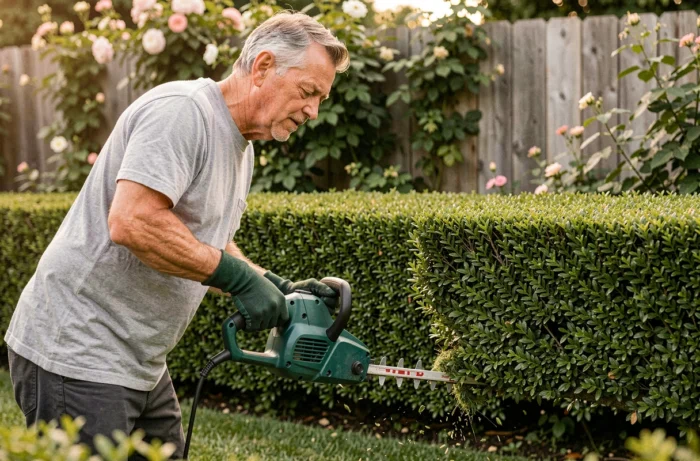
Your hedge grows quickly, the branches extend into the neighbor’s yard, and you’re hesitating between three models of electric hedge trimmers in the gardening section. The price alone isn’t enough to make a decision. What makes the difference is the combination of the blade, power, and weight, tailored to your specific hedge. Here’s how to make the right choice without regrets.
Noise and electric hedge trimmers: a constraint often overlooked
Before even discussing blade or power, one parameter dictates your tool choice: the legal noise regulations set by your municipality. There is no single national rule. It is the municipal or prefectural decrees that define the allowed time slots, often around 8:30 AM to 12 PM and 2:30 PM to 7:30 PM on weekdays, with shorter periods on Saturdays and sometimes just a window from 10 AM to 12 PM on Sundays.
A corded hedge trimmer plugged into the mains already produces less noise than a gas model. A battery-powered model goes even further in terms of sound discretion. If you live in a housing estate or a densely populated area, this criterion carries significant weight. Being able to trim early in the morning without sparking a neighbor dispute is a real daily advantage.
Online comparisons on taille-haie-electrique.com allow you to filter models based on their noise level, which helps to cross-reference this criterion with other technical characteristics.
Blade length and tooth spacing: adapting the tool to the hedge
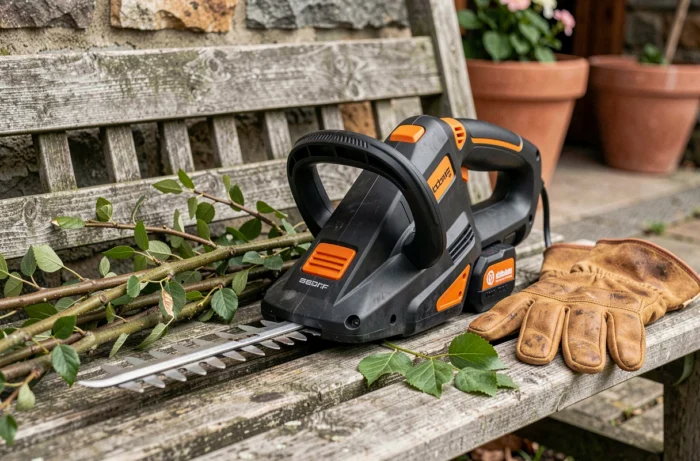
You may have noticed that the same hedge trimmer cuts the privet cleanly but tears the branches of the laurel? The reason lies in two parameters related to the blade.
Blade length according to hedge width
A short blade (around 45 cm) is suitable for narrow hedges and topiaries. It offers more precision for shaped work. A long blade (60 cm and more) covers a wide hedge in fewer passes, but it is heavier and less maneuverable in corners.
The rule is simple: the blade must be at least as long as the thickness of your hedge. If your hedge is 50 cm wide, a 45 cm blade will require two passes, which doubles the working time and results in a less clean finish.
Tooth spacing according to branch diameter
The spacing between the teeth of the blade determines the maximum diameter of branches that the tool can cut cleanly. Here’s how to choose:
- A narrow spacing (around 16 mm) is suitable for boxwood, cypress, or hornbeam hedges, whose branches remain thin if trimmed regularly.
- A medium spacing (between 20 and 25 mm) adapts to thuja, privet, or photinia, which produce semi-woody branches.
- A wide spacing (over 25 mm) is intended for cherry laurel, forsythia, or eleagnus, whose branches quickly become thick.
Cutting a branch that is too thick for the spacing damages the teeth and strains the motor. The result: ragged cuts that weaken the plant and promote diseases.
Power and weight of the electric hedge trimmer: finding the right balance
Why does this criterion deserve attention? Because power and weight evolve together, and a tool that is too heavy for you will become unusable after twenty minutes.
Motor power according to use
For a corded electric hedge trimmer, power is measured in watts. Entry-level models hover around 400 W. They are sufficient for a low and thin hedge, trimmed frequently. For a dense or poorly maintained hedge, aim for at least 500 to 600 W so that the motor doesn’t stall in thick branches.
On a battery model, the voltage (in volts) gives a comparable indication. The higher the voltage, the more torque the motor has to cut through resistant branches.
Weight, a decisive criterion for long sessions
A hedge trimmer is held at arm’s length, often above your head to reach the top of the hedge. Every extra kilo is felt after a few minutes of working at height.
Corded models remain the lightest, as they do not carry a battery or tank. Battery models weigh more but offer freedom of movement. If your hedge is over twenty meters long, this freedom more than compensates for the extra weight.

Corded or battery: which electric hedge trimmer for your garden
The choice between corded and battery isn’t just a budget question. It’s a matter of terrain configuration.
- The corded hedge trimmer works as long as it is plugged in, with no autonomy limits. It is suitable for hedges located near an outdoor outlet. Beware of the extension cord: a cable coiled on a reel can heat up, even melt if the tool’s power is high. Always unroll the extension cord completely.
- The battery-powered hedge trimmer frees your movements and eliminates the risk of cutting the cord while trimming. Its autonomy varies according to the battery capacity and the thickness of the branches being cut. Plan for a second battery if your hedge exceeds thirty meters in length.
- The telescopic pole model (corded or battery) allows you to reach the top of a tall hedge without a ladder. It is heavier and less precise, but it avoids working in an unstable position.
One last often-forgotten point: the nesting period of birds. The French Office for Biodiversity recommends avoiding hedge trimming from March 15 to July 31. Planning your trimming sessions outside this window protects wildlife and prevents you from having to trim urgently with a poorly chosen tool.
The best electric hedge trimmer is not the most powerful or the most expensive. It is the one whose blade matches your hedge, whose weight remains manageable for the duration of your task, and whose noise level allows you to work at times that suit you. Start from your hedge, not from the catalog.