
You are abroad, your mobile credit is at zero, and you urgently need to contact a loved one in France. This is exactly the type of situation for which collect calls were designed. This mode of communication, where the recipient bears the cost of the call, remains little known even though it can be helpful in very specific cases. Let’s see how it works in practice, what has changed, and what alternatives are available to you today.
Collect Call from a Landline: The Concrete Procedure
On a landline in France, the historical method relies on the number 3006. You dial this number (free), then enter the number of the person you wish to reach. A voice server announces the call to the recipient, who can choose to accept or refuse the charges.
By default, every landline is configured to receive collect calls. The line holder can disable this option or protect it with an access code by calling 3000. If the code option is active, the caller will need to provide it before the connection is made.
When trying to make a collect call from a phone, it is often because there is no immediate payment method available. The cost of the call is then billed to the recipient, at the rate of a local or national call depending on the distance, sometimes with a slight surcharge related to the service.
Only the recipient pays, and only if they accept the call. No fees are charged to the caller. This is a point that is often misunderstood.
Collect Calls from a Mobile: Why It Has Become Complicated
The collect call system was designed for landline telephony and public booths. On a mobile phone, the situation is quite different. Most French mobile operators do not offer an integrated collect call service in their plans. The number 3006 works from a landline, but its access from a mobile is not guaranteed depending on the operator and the type of plan.
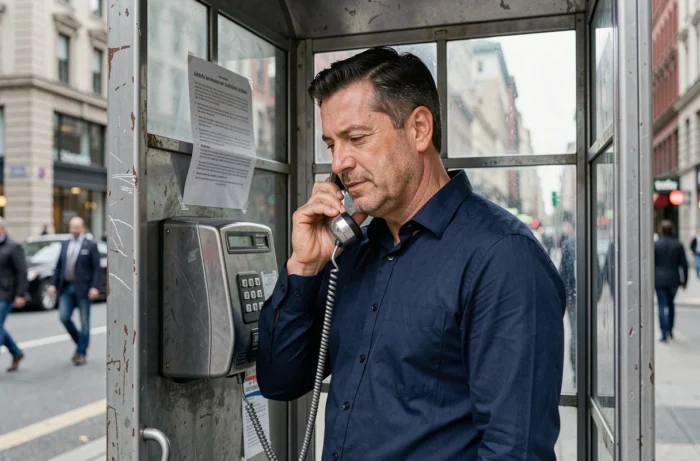
Public telephone booths, which used to allow making a collect call without a card or coins, have practically disappeared from the territory. This leaves us in a technical deadlock for emergency situations without mobile credit.
What Technically Blocks It
- Short numbers like 3006 are sometimes inaccessible from mobile networks, depending on agreements between the operator and the collect call service provider.
- Blocked plans or prepaid cards without credit often prevent calls to special numbers, even free ones.
- The copper network, which supported the historical collect call infrastructure, is being phased out. Arcep has initiated the process of designating a new operator for the universal telephone service mission starting in 2027, specifying that this obligation can no longer rely on copper but on fiber optics or 4G/5G mobile networks.
The collect call system as we knew it has not been adapted to the mobile world. It is a service designed for a network that is gradually disappearing.
VoIP Alternatives and Free Calls: What Replaces Collect Calls in Practice
When you run out of credit and need to make a call, VoIP solutions via Wi-Fi take over. WhatsApp, Signal, or Telegram allow you to make free voice calls as long as you have an internet connection, even a weak one.
This is the most reliable solution on the ground today. A public Wi-Fi network (train station, hotel, library) is enough to reach a loved one. No phone credit is needed, just an internet connection.
VoIP Applications: Points to Check
Not all applications are created equal. Some consume more data, while others require the recipient to use the same application. On a slow Wi-Fi network, prioritize voice calls without video to limit bandwidth usage.
For situations abroad, these applications bypass roaming charges. This avoids the unpleasant surprise of an inflated bill upon return.

Emergency Calls Without a Plan: The Safety Net to Know
One point that guides on collect calls rarely mention: in France, emergency numbers (15, 17, 18, 112, 115) are accessible from any phone, even without an active subscription. This obligation is part of the universal service framework maintained by Arcep.
In practice, a mobile without a SIM card or with an expired plan can still dial 112. This is not a collect call in the strict sense, but it covers the most critical need: reporting an emergency without payment means.
When Collect Calls Still Make Sense
Collect calls remain relevant in a specific case: contacting an individual on their landline from another landline, without paying for the call yourself. This is typically the case for a child at summer camp calling their parents, or a person temporarily housed without a personal phone.
Outside of this scenario, digital alternatives cover the same need with more flexibility. Feedback varies on the actual availability of 3006 depending on regions and operators, making the VoIP solution more predictable.
Collect calls have not completely disappeared, but their use has reduced to a niche. For the majority of situations where one seeks to call without credit, a VoIP application on a public Wi-Fi network remains the most accessible method. The reflex to maintain: locate a Wi-Fi access point before finding yourself without a solution, and keep at least one calling application installed on your phone.