
A designer who publishes illustrations for a children’s publisher and a concept artist working on a AAA video game sometimes use the same tools. However, their professional daily lives have almost nothing in common. The opportunities, payment methods, and skills sought by clients diverge to the point of constituting two distinct professions, even if the basic act remains drawing.
Concept Art Market: Entry Doors Closing for Juniors
Are you looking for your first position as a concept artist in video games or animated cinema? The situation has changed since 2023. On professional forums, discussions are multiplying around a common observation: junior offers in concept art have nearly disappeared. Studios are now hiring mid or senior profiles, with several titles delivered under their belt.
This filtering is not a coincidence. Production budgets are concentrating on fewer, more expensive projects. Artistic teams are tightening, and art directors want people who are operational from day one. For a beginner, entering through the front door today means having already built a personal portfolio at a level comparable to that of a professional who has been active for several years.
In freelance illustration, access to the market works differently. Assignments remain accessible through more modest commissions (corporate communication, publishing, web content, social media). The barrier to entry is less technical and more commercial: one must know how to find clients and set a viable rate. These are two paths to make a living from drawing that require very different insertion strategies.
Freelance Illustrator: A Niche Business, Not Just Drawing
Knowing how to draw is not enough to make a living from illustration. Professional guides published in 2024 and 2025 emphasize a point that many beginners underestimate: commercial positioning matters as much as technical skill.
Choosing a Clear Niche to Stand Out
Children’s illustration, branding, 2D video games, illustrated web, motion design: each segment has its codes, rates, and clients. An illustrator who presents themselves as a “generalist” struggles to convince. Why? Because an art director looking for a specific style for a book cover will not look at a portfolio filled with concept art of medieval armor.
Choosing a specialty shapes everything else: the style of the portfolio, the networks to publish in, the fairs to exhibit at, the publishers or agencies to approach.
Calculating a Realistic Daily Rate
Setting prices “per drawing” often leads to underbilling. The recommended method is to establish a daily average rate based on actual costs and an annual income goal, divided by the number of days actually worked. This calculation includes contributions, materials, and non-billable days (prospecting, administration, training).
An illustrator who ignores this logic ends up working a lot for little pay. Financial competence is part of the job just as much as mastering digital drawing.
Concept Art and Illustration: Technical Skills Diverging
Have you noticed that the portfolios of concept artists and illustrators do not look alike, even when both draw characters? The reason lies in production expectations.
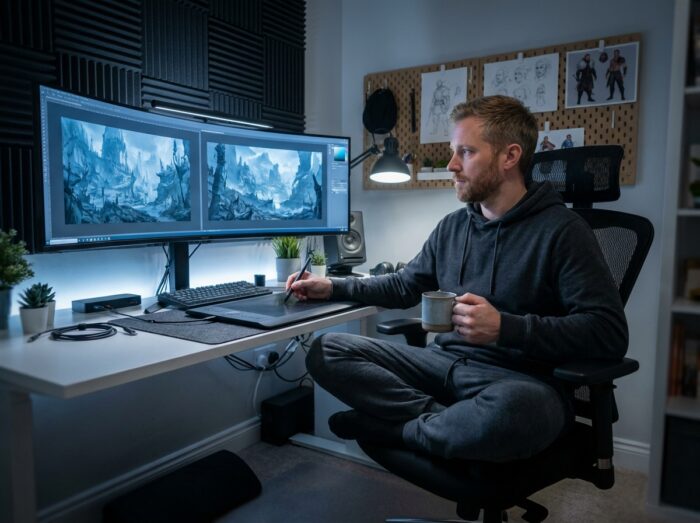
A concept artist produces visuals intended to guide a team. Their images serve as references for 3D modelers, animators, or level designers. The priority is on readability, coherence with a universe, and the ability to iterate quickly. Concept art is an internal communication tool, not a final artwork.
The illustrator, on the other hand, delivers a finished image. It will be seen by the public, printed on a cover, displayed on a website. The attention given to composition, lighting, and surface details is more intense. The time spent per image is often longer.
This distinction has concrete consequences on the skills to develop:
- The concept artist must master shape design, quick perspective, photobashing, and often supplementary 3D (to establish volumes before painting over).
- The illustrator invests more in visual storytelling, color management, cover typography, and sometimes editorial layout.
- Both need solid fundamentals (anatomy, light, color), but apply them in opposite delivery contexts: speed and iteration on one side, finishing and visual impact on the other.

Online Visibility and Portfolio: Adapting Strategy to the Right Audience
A freelance illustrator’s portfolio and a concept artist’s portfolio do not target the same people. The former targets end clients (publishers, communication agencies, startups). The latter aims at studio recruiters or internal art directors.
Online presence must be structured around the chosen niche. For the illustrator, this means a personal website with projects categorized by type of commission, an active presence on relevant networks, and increasingly, an email marketing strategy to retain existing clients. Participation in professional fairs (children’s illustration, comics, graphic design) remains a lever for acquiring direct contacts.
For the concept artist, ArtStation remains the reference platform. Recruiters search for profiles by specialty (character design, environment design, prop design). A portfolio that is too diverse dilutes the message. It is better to show twenty coherent pieces in one area than fifty scattered images.
The common trap for both profiles: publishing a lot without targeting anyone. Posting daily on Instagram without a content strategy does not replace a well-organized portfolio and targeted outreach.
Whether one leans towards illustration or concept art, the ability to clearly position oneself in a segment, calculate rates, and build coherent visibility determines the project’s viability. The level of drawing opens doors, but it is professional structuring that allows one to stay there.