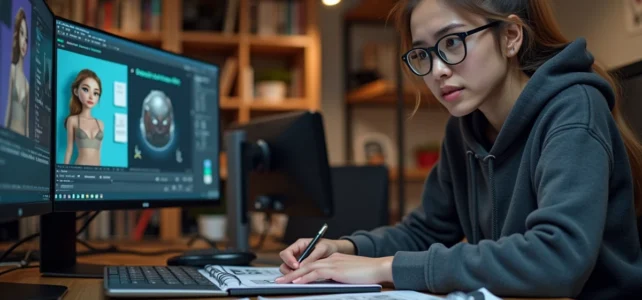
A candidate who opens Blender for the first time in September and submits their application in March faces a concrete problem: the juries of 3D animation and special effects schools are not looking for advanced software mastery, but for a personal approach that can be understood in a few seconds. The admission portfolio acts as a quick filter.
If the navigation is confusing, if the pieces are poorly organized, or if the portfolio looks like a compilation of YouTube tutorials, the jury moves on to the next candidate.
Multi-platform portfolio: what juries evaluate first
Most specialized schools (ESMA, ArtFX, Gobelins) now expect an online accessible portfolio, not a forty-page PDF sent by email. The principle is simple: one link, one click, smooth reading. A portfolio site on Behance, ArtStation, or personal hosting will do, as long as the loading is fast and the navigation remains intuitive.
This is a matter of drastic selection. Five to ten projects are enough. Each project must show a clear intention: the brief you set for yourself, the research steps, the final rendering. ESMA explicitly recommends the principle of “less is more” and warns against portfolios that drown the reader in unnecessary information.
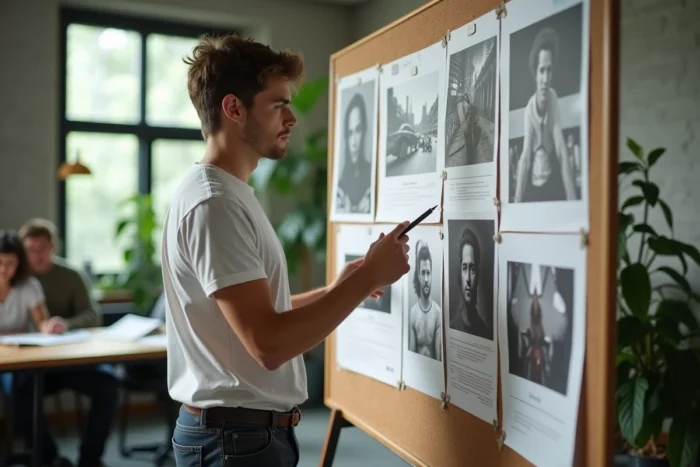
The classic trap is to pile up 3D renderings without context. A jury wants to understand your process, not admire a shader. Add preparatory sketches, research boards, and short intention notes. It’s this layer of reflection that distinguishes a candidate’s portfolio from a gallery of fan art. For more in-depth structuring of such a portfolio, useful guidelines can be found on the special effects training on Raconte-moi which details the expectations by type of course.
Admission weighting for 3D animation: portfolio, motivation, academic record
In recent years, several 3D animation and special effects schools have formalized the distribution among the different evaluation criteria. The portfolio alone is no longer enough to secure a spot. The motivation letter, structured CV, academic record, and oral interview each carry weight in the balance.
In practical terms, this changes the preparation strategy. A candidate with an excellent portfolio but a generic letter like “I’ve dreamed of doing 3D since I was little” can be overtaken by someone whose professional project is precise and documented.
Motivation letter: talk about the project, not the dream
The letter must answer an operational question: why this school, and not another, to achieve what specific professional goal. Mention a department of the school, an instructor, a student project you have noticed. Show that you have done your research.
Avoid hollow phrases about passion. Instead, describe a recent personal project, the problems encountered, the technical choices made. It’s this level of detail that signals a serious candidate.
Oral interview: what sways the jury
ArtFX specifies in its admission guide that the interview serves to assess cultural curiosity and the ability to discuss one’s own work with perspective. You will likely be asked to comment on a piece from your portfolio. Prepare a critical analysis of your own weaknesses: a rendering you would do differently, a technique you have not yet mastered.
Feedback varies among schools regarding the exact weight of the oral interview, but the pattern remains the same: the jury tests your ability to progress, not your current level.
Building a 3D animation portfolio with a personal voice
Juries quickly spot portfolios built solely on “trendy styles” without personal signature. A portfolio filled with stylized characters copied from popular references reveals nothing about you. What matters is the coherence between your aesthetic choices and your approach.
- Vary the media: traditional drawing, sculpture, photography, 3D modeling. A portfolio that shows multiple mediums demonstrates a plastic curiosity that schools actively seek.
- Include at least one complete narrative project: storyboard, character research, setting, even if brief. The ability to tell a visual story carries significant weight in animation.
- Document your failed experiments. A board of abandoned sketches with a note explaining why you changed direction shows more maturity than a polished rendering without context.
- If you are applying for special effects, show a basic compositing work (integration of a 3D element into a real shot). The jury wants to see that you understand the link between shooting and post-production.
The coherence of the portfolio takes precedence over the technicality of each piece. It’s better to have eight projects that respond to each other and outline a universe than twenty disparate renderings.
Common mistakes in special effects admission portfolios
The first reflex to correct: sending a file that is too large. A PDF of several hundred megabytes clogs the jury’s email or slows down loading. Optimize each image for the web without sacrificing readability.
Another common mistake: neglecting the academic dimension. Some post-bac schools require a correct academic record, particularly in general subjects. A brilliant candidate in drawing but with unaddressed gaps in general knowledge may be rejected at the interview.
- Do not plagiarize existing concept art without mentioning it as a study. Juries know industry references and spot copies.
- Avoid demo reels longer than two minutes. A well-edited minute, with your best shots at the beginning, is more than enough.
- Do not underestimate layout. A visually organized portfolio (clear grid, sober typography, neutral background) facilitates reading and gives an impression of rigor.
Several schools now offer integrated 3D refresher modules in the first year for less technical profiles. If your strength is drawing or storytelling, own it in your portfolio rather than forcing a mediocre 3D rendering. The jury prefers a good motivated draftsman over an approximate modeler who hides their shortcomings.
The admission portfolio for 3D animation and special effects should be prepared like a production project: with a timeline, iterations, and external feedback. Have someone from the industry review your portfolio before sending it. A fresh perspective can spot inconsistencies in five minutes that you no longer see after weeks of work.