A child who struggles with the same dictation every week ends up associating spelling with failure. We see it in classrooms, in homework: the mechanical repetition of words does not solidify anything if there is no desire. Revising spelling while having fun is not a pedagogical slogan; it is a concrete condition for lasting memorization.
Why play alone is not enough to improve spelling
One could multiply card games or applications without seeing any real progress in writing. The reason is documented: according to a study by Garcés-Díaz and Barzola-Andrade published in September 2026, the generalization of acquired skills to new writings is rarely evaluated in playful settings. The correctly spelled word during the game does not necessarily appear in the writing the next day.
The problem lies in the format. Many playful activities remain at the stage of isolated words: letters are sorted, gaps are filled, intruders are guessed. The child engages their visual memory on a specific item but never practices the complete sentence. Yet it is in the sentence that agreements, homophones, and punctuation come into play.
For a spelling game to produce a measurable effect, it must lead to a writing task, even a short one. Two dictated sentences after a card game, a mini-text to write using the words practiced: this extension makes all the difference. This approach can be found in the playful method on Greg From Paris, which combines semantic games and writing tasks.
Cross-curricular spelling: integrating revisions outside of French class
The new French school programs for the 2026-2027 school year make spelling a shared responsibility across all subjects. The Ministry of National Education specifies that correct writing becomes a cross-curricular objective, not just reserved for French lessons.
In practice, this opens up a much broader playground. A report of an experiment in science, a caption for a map in history, a reformulated problem statement in mathematics: each subject becomes an opportunity to work on spelling without the child feeling like they are “doing French.”
Three concrete situations to revise without a rulebook
- In science, ask the child to write the protocol for an experiment in three sentences. Together, we correct subject-verb agreements and the spelling of technical words, which are often new words to memorize.
- In history or geography, have them write a short caption under an image or a sketch. The exercise forces them to choose the right homophones (“ces/ses”, “ou/où”) in a meaningful context.
- In daily life, the shopping list or the message left on the breakfast table becomes a natural micro-dictation. The child writes for someone, not for a grade.
The advantage of this approach is that spelling ceases to be a separate subject and becomes a global writing reflex. Feedback on this point varies according to the child’s age, but from CE2 onwards, cross-curricularity produces visible results in writing fluency.
Choosing the right playful format according to the child’s level
Not all spelling games are suitable for all ages. A board game with complex rules discourages a first-grade student, while a simple syllable memory game bores a fifth-grader. The choice of format conditions engagement.
From CP to CE2: prioritizing visual memory and action
At this age, we focus on the overall shape of the word. The games that work are those where the child sees the whole word, mentally photographs it, and then reconstructs it. Wooden movable letters, manipulable labels, words written with a finger in sand or semolina: the physical engagement anchors memorization.
Handwriting plays a direct role. Typing a word on a screen does not engage the same circuits as writing it by hand. For younger children, the act of writing remains an ally that digital tools cannot replace.
From CM1 to CM2: strategy games and peer challenges
Children in cycle 3 need gentle competition or cooperation to stay motivated. Card games like spelling challenges, where they must spot the error in a sentence before their opponent, combine quick reading, grammar, and lexical spelling.
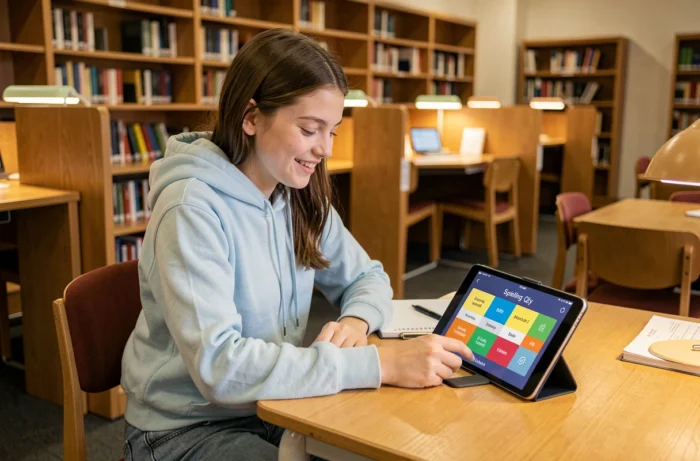
This is also the age when digital applications make sense, provided they offer complete sentences and not just multiple-choice questions on isolated words. A good digital tool for spelling requires the child to write, not just click.
Spelling assessment: what changes from 2026
A service note dated August 25, 2025, modifies the assessment methods for spelling in exams starting from the 2026 session. This institutional change is not trivial: it indicates that mastery of written language carries more weight in grading.
For families and teachers, this makes regular spelling work in real writing contexts even more relevant. Preparing for an exam by accumulating lists of words no longer meets expectations. The assessments value the ability to produce a correctly spelled text, with mastered agreements and coherent punctuation.
In practical terms, a playful method that stops at letter games misses this target. The game must serve as a springboard to writing. Even ten minutes of free writing after a playful activity builds a habit that the weekly dictation alone does not create.
Spelling does not need to be made “fun” through gimmicks. It becomes natural when the child writes often, in varied contexts, with kind feedback on their mistakes. The game sparks desire, writing establishes competence.