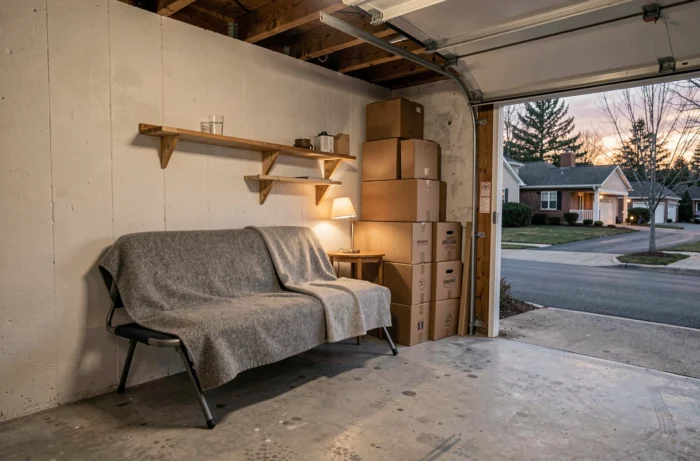
Installing a mattress in the garage to spend the night is an idea that crosses the mind when space is lacking, when hosting a relative, or when looking for a temporary solution. However, sleeping in your garage raises concrete questions: does the regulation allow it, is the air breathable, and is minimal comfort achievable?
Change of use for the garage: what the urban planning code says
A garage is classified as a parking space in urban planning documents. Sleeping there, even occasionally, amounts to changing its use. This distinction is not an administrative detail: it conditions everything else.
The removal of a parking space or the creation of living space may require prior declaration or even a building permit depending on the area concerned and the rules of the Local Urban Plan (PLU). The applicable regime depends in particular on the area created and any modification of the facade. Each municipality can set specific rules, and the only reliable approach is to consult the urban planning department of the town hall before any modifications.
You can learn more on Le Blog de Coco which details the different situations faced by property owners.
In a co-ownership, the question becomes even more complicated. The co-ownership regulations specify the authorized use of each lot. Transforming a garage into a sleeping space without the agreement of the general assembly exposes one to challenges from other co-owners.
Ventilation and air quality in a closed garage

This is the most underestimated and dangerous point. A standard garage is not designed for breathing for several hours at a time. The lack of adequate ventilation is the main risk when considering sleeping there.
Garages often house vehicles, paint cans, solvents, and cleaning products. These substances release volatile organic compounds (VOCs) even when the containers are closed. A briefly started engine in a closed garage is enough to produce carbon monoxide in problematic quantities.
Natural or mechanical ventilation: what changes the game
A garage with a simple tilting door and no additional openings does not renew the air properly. For a space to be considered habitable, it requires a ventilation system that ensures sufficient air flow, whether natural (opening window, high and low vents) or mechanical (VMC).
- Check for at least two opposing ventilation points to create a cross-flow of air
- Remove any stored chemicals (paints, fuels, solvents) before considering spending a night there
- Install a carbon monoxide detector, especially if a vehicle is parked in the same space
- Never obstruct existing ventilation grilles, even to limit cold or noise
Sleeping in an unventilated garage exposes one to silent poisoning, as carbon monoxide is odorless. This risk is not theoretical: it concerns any poorly ventilated room where sources of combustion or pollution exist.
Decency criteria for housing: the garage is far from it
If the idea is to rent a converted garage or to host someone there long-term, the regulations on decent housing apply. A space originally designed for parking a vehicle generally does not meet these criteria.
The requirements focus on several simultaneous points: minimum area or volume, natural lighting, ventilation, electrical safety, and heating. A typical garage fails on most of these criteria. No window, no thermal insulation, a bare concrete slab, a metal door that lets in the cold.
The trap of renting a garage as a bedroom
Offering a garage converted into a bedroom to a tenant exposes one to having the housing declared indecent. The tenant can then refer the matter to the departmental conciliation commission or the court. The owner risks being forced to relocate the tenant or to carry out compliance work.
A garage converted without authorization cannot be rented as housing. This rule protects both the tenant and the owner, who faces penalties in the event of an inspection.
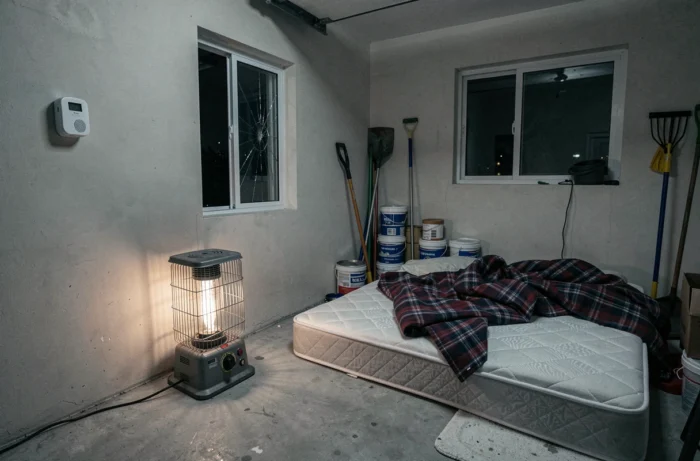
Thermal comfort and insulation: making a garage livable
Even outside the rental framework, sleeping in an uninsulated garage is a physical ordeal. The concrete block walls and slab conduct cold. In winter, the indoor temperature of an unheated garage follows that of the outside with only a few degrees of difference.
Insulating a garage to make it comfortable requires intervention on the walls, ceiling, and floor. Internal insulation remains the most common solution, but it reduces usable space. The floor requires specific treatment: a bare concrete slab generates moisture through capillary rise, which quickly degrades a mattress placed on the floor.
- Install insulation on the floor with a vapor barrier before placing any bedding
- Treat the walls with insulation suitable for unheated spaces (extruded polystyrene, rock wool)
- Provide an electric auxiliary heater rather than a combustion heater, to avoid any production of carbon monoxide
Humidity remains the recurring problem of garages. Without active dehumidification or proper ventilation, mold appears within weeks on textiles and mattresses.
Safety and insurance: the blind spots to anticipate
Sleeping in a garage changes the nature of the risk covered by home insurance. An incident occurring in a space used outside its declared purpose may not be compensated. Before any installation, informing the insurer of the change of use is a precaution that avoids a refusal of coverage in case of fire or water damage.
On the fire safety side, a garage often houses flammable materials. Adding bedding, textiles, and an auxiliary heater increases the risk. A functional smoke detector and an accessible fire extinguisher are the minimum to provide.
Sleeping in your garage is not prohibited in itself, but each step, from ventilation to urban planning, poses a specific technical or regulatory constraint. The feasibility depends entirely on the configuration of the garage and local rules. Before rolling out a mattress on the slab, the first reflex remains to check the PLU and ensure proper ventilation of the space.