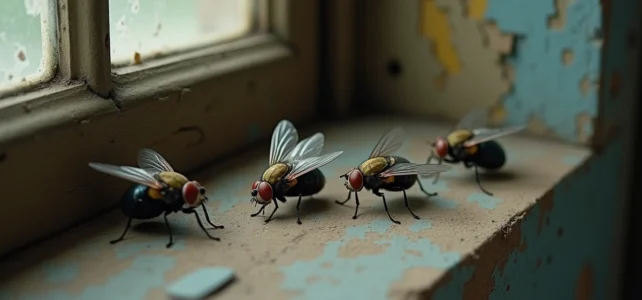
The dead fly on a windowsill or at the bottom of a light fixture rarely goes unnoticed. This insect, associated with decay and impurity in most traditions, provokes a reaction that goes beyond mere disgust. Several spiritual currents attribute to the dead fly a function as a mirror, a reflection of what stagnates in our inner life.
Recent work in environmental psychology adds a complementary reading: our sensitivity to micro nuisances in the home (insects, dirt, low noises) would be correlated with our level of chronic stress.
Hypervigilance and dead flies: what environmental psychology documents
Online spiritual content explains the dead fly through negative energies or messages from the universe. Before venturing into this territory, a detour through environmental psychology research provides a more verifiable insight.
Recent syntheses on the impact of minor nuisances on emotional well-being show that focusing attention on small domestic nuisances is a marker of anxious hypervigilance. A person experiencing cognitive overload or close to exhaustion is more likely to notice dead flies, smudges on windows, and neighborhood noises. The problem does not stem from the insect, but from the nervous state that amplifies its perception.
In other words, systematically noticing dead flies in one’s home may signal a high level of stress before indicating anything metaphysical. This framework does not negate the symbolic dimension, but it establishes a factual basis that almost all competing articles ignore. Understanding the spiritual message of dead flies gains relevance when one has first ruled out (or confirmed) an identifiable psychological cause.

Dead fly and spiritual meaning: three interpretations according to traditions
The fly does not have the prestige of the butterfly nor the nobility of the raven in the symbolic bestiary. Its association with putrefaction and waste places it on the side of what disturbs. However, several traditions assign it a specific role, and the dead fly carries a distinct message from the living fly.
Decomposition and the cycle of transformation
In cosmologies where nature operates in cycles, the dead fly represents the end of a process of inner decomposition. The idea is not that something “dies” in your life, but that a phase of stagnation comes to an end. The living fly symbolizes agitation, mental noise, perseverance in the face of obstacles. Its death would mark the exhaustion of this scattered energy.
Impurity expelled in Abrahamic traditions
The Bible mentions Baal Zebub (literally “lord of the flies”), a Philistine deity associated with corruption. In this lineage, the fly represents spiritual pollution. Finding a dead fly would mean that a negative influence has lost its grip. This interpretation remains vivid in some contemporary charismatic currents, where the death of the insect is seen as a sign of purification of the domestic environment.
Totem animal and extinguished perseverance
In Western neo-shamanic approaches, the fly is among the minor totem animals. The living insect embodies tenacity and adaptation. Its death, in this context, poses a direct question: have you given up a fight that deserved to be continued, or have you finally let go of something useless? Both interpretations coexist, and practitioners generally invite one to observe the emotional context of the moment to decide.
Quality of the inner environment: when the dead fly speaks of housing
One aspect rarely addressed in spiritual articles concerns the documented link between the repeated presence of dead flies and the indoor air quality of a home. Flies that die in large numbers in a closed room may indicate a problem with humidity, poor ventilation, or decomposing organic matter (pipes, poorly insulated attic).
The repetition of the phenomenon warrants a material check before any symbolic reading. A poorly ventilated home promotes the proliferation of flies that ultimately die on-site. Attributing a spiritual meaning to a sanitation issue may delay a useful intervention.
This distinction is not anecdotal. It aligns with the findings of environmental psychology: our perception of our habitat reflects our inner state, but our habitat also concretely affects our mental health. Both directions operate simultaneously.
Dead fly in a dream or in synchronicity: interpretation framework
The dead fly also appears in dreams and in what some currents call synchronicities (meaningful coincidences). Here are the main axes of interpretation found in symbolic traditions:
- Isolated dead fly, found by chance: end of a recurring irritation, resolution of a minor conflict that has long been parasitizing attention.
- Many dead flies: signal of a necessary cleaning, both literally (habitat) and figuratively (toxic relationships, worn habits).
- Dead fly in a recurring dream: projection of guilt or regret related to a situation that the dreamer considers “dirty” or shameful.
- Dead fly on a personal object (clothing, book, pillow): in animistic approaches, this specific placement directs the interpretation towards the domain that the object represents (work, intimacy, thought).
These frameworks do not constitute universal truths. They function as projection tools: what you read into the dead fly says more about your current concern than about the insect itself.
Inner life and animal symbolism: what the dead fly does not say
Attributing a spiritual message to a dead insect carries a limit rarely mentioned: confirmation bias systematically directs interpretation. If you are going through a difficult time, you will find in the dead fly the confirmation of discomfort. If you feel renewed, you will see it as the end of a negative cycle. The symbol works in both directions, raising questions about its predictive value.
Traditions that include the fly in their spiritual bestiary never treat it in isolation. Context, season, emotional state of the person, recurrence of the phenomenon: all these elements contribute to the interpretation. Extracting the dead fly from its context to impose a single meaning is more of a shortcut than spirituality.
The dead fly remains an entry point for introspection, not an oracle. Checking the state of one’s housing, evaluating one’s stress level, and only then questioning the symbolic dimension: this order of priority allows one to use the sign without being trapped by it.