
The size L does not mean the same thing everywhere. An L purchased in France, the United States, or Japan can correspond to very different measurements. Understanding the equivalence of size L in clothing is primarily about knowing how to read the centimeters behind the letter.
Why size L varies by country and brand
Have you ever ordered a size L t-shirt from a foreign site, only to receive it too tight or too loose? The problem does not lie with your body. It comes from the sizing system used by the manufacturer.
In France, size L generally corresponds to 40-42 for women and 50-52 for men. In the United States, a women’s L is more like a 10-12 US, which is a 42-44 French. In the United Kingdom, the same women’s L translates to a 14-16 UK. To understand the equivalence of size L in clothing, it is therefore essential to always check the country of origin of the garment.
For men, the gap is sometimes even more pronounced. An American L often fits wider than a European L, with a chest measurement that can exceed what a French L covers. Asian brands, on the other hand, generally size smaller: a Japanese L is closer to a European M.
The problem becomes more complicated with the brands themselves. Two French brands can offer an L with different measurements. Some practice “vanity sizing,” slightly widening the measurements so that the customer feels good in a smaller size. The result: the letter L has no absolute value without the accompanying centimeters.

Chest, waist, and hip measurements: the concrete measurements for women’s L
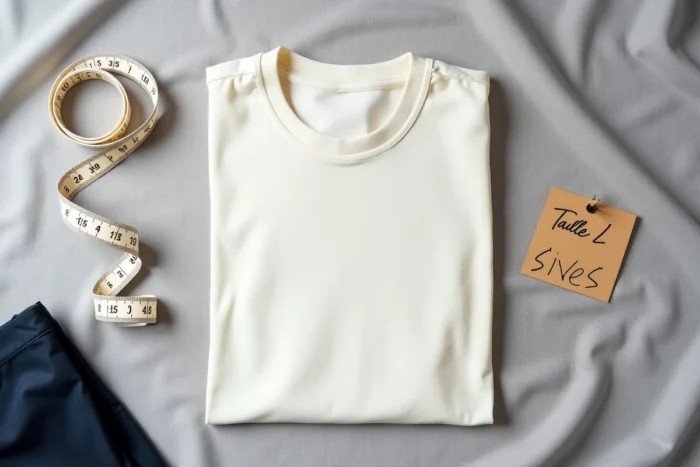
To know if a size L garment will fit you, three measurements are enough. And they can be taken in less than two minutes with a measuring tape.
Measurements for women’s tops in size L
For a top, blouse, or jacket, the main measurement is the chest circumference. In women’s size L (equivalent to 40-42 French), it ranges from 90 to 98 cm according to size charts. The corresponding waist measurement goes from 70 to 78 cm.
Measure your chest at the fullest point, without tightening the tape. If you get 92 cm, you are within the L range. At 88 cm, an M will likely fit better.
Measurements for women’s bottoms in size L
For pants, a skirt, or a dress, the hip measurement becomes the key measurement. In women’s L, it ranges from 96 to 104 cm. The waist measurement remains in the same range as for tops (70 to 78 cm).
Always measure the hip at the widest point of the hips, not at the waist. This is the most common mistake. A size L jean that is tight at the hips but loose at the waist often indicates an A-shaped body, where you should choose the size of the bottom based on the hips, not the waist.
Men’s size L: different benchmarks
The system is the same, but the numbers change. A men’s L in France corresponds to a 50-52 French.
| Measurement | Men’s L (France) |
|---|---|
| Chest circumference | Approximately 100 to 108 cm |
| Waist circumference | Approximately 86 to 94 cm |
| Inseam (pants) | Variable depending on the cut |
For shirts, the neck measurement also comes into play. But in standard ready-to-wear, the chest circumference remains the main criterion for choosing a men’s L.
Be cautious with garments labeled “L” in streetwear or sportswear brands. These cuts are often looser (relaxed or oversized fit), and an L may correspond to the measurements of an M in a suit brand.
International size L equivalence chart
Here is a summary of the most common equivalences for size L, for both women and men. These values are indicative: each brand may deviate from them.
| System | Women’s L | Men’s L |
|---|---|---|
| France | 40-42 | 50-52 |
| Europe (EU) | 40-42 | 50-52 |
| United States (US) | 10-12 | L (no standard number) |
| United Kingdom (UK) | 14-16 | L |
The American system uses even numbers for women, while men stick to the letters S/M/L/XL. The classic trap: confusing US size with EU size, as a 10 US has nothing to do with a 10 EU (which would be a children’s size).
Choosing your size L online: three reflexes to adopt
Ordering a garment without trying it on requires cross-referencing several pieces of information. The letter alone is never enough.
- Check the brand’s size guide on the product page. Size charts vary from one site to another, and the brand-specific guide takes precedence over any generic chart.
- Compare your actual measurements (chest, waist, hip) with the chart, in centimeters. Do not rely on your usual size from another brand.
- Check the country of origin of the garment. An L made for the Asian market will size smaller than an L designed for the North American market.
A detail often overlooked: the fabric material. A raw cotton L may shrink in the wash, while a stretch jersey L will forgive a few centimeters of difference. Always take the fabric into account before deciding between two sizes.
The best reflex is to note your measurements once and for all and keep them handy. Bodies change, but the measuring tape does not lie, unlike the letters on the labels.